Sunday, April 26, 2015

Germany

Germany

Usually I start with a map, or a historic picture, but the picture at left lets you in a bit more on who I am as a person.  You see, I have an immediate gratification problem.  The picture to the left is proof of that, because it is a classic bottle used for bottling German wine from Franken, one of the 13 wine regions of Germany.  As you probably guessed, like the Fiasco in Italy, this does not usually carry the best quality German wine, but it sure is a cool bottle.

It is also my FAVORITE part of the education I have received to date on Germany.  The Bottle you see is called a Bocksbeutel.  Funny right?  

I should probably translate, then surely you will get it.  Bocksbeutel in German translates to goat scrotum.  Now it is funny right!!!! Couldn't wait to get back home to type that. 

German wine is not unlike their cars.  It is crisp, it is well made, it is technical in its approach.  It is also great, and some might argue that a German Riesling is the best white wine made on the planet.  I will also say that like the cars, the good ones can be very expensive.  It is said that German wines represent place in much the same ways that the great Burgundy wines do.  Incidentally,  Burgundy is the other region often argued to have the greatest wines in the world both reds and whites.  Why we need to argue over whose is better, I will never know, I say drink them both.

As you can see the German wine region is largely distributed in the southwest corner of the country.  There are 13 wine making regions in Germany making varying levels and qualities of wines.  The country is so far North, that ripening of grapes is a challenge in most years regardless of where a vineyard is located.  The best vineyards face South, giving the grapes optimal sun exposure, and therefore the best chance of adequately ripening.  The best vineyards are protected either by forest, mountains, or by water from the elements and sometimes all of the above.  That is why German Vineyards hug the rivers on seemingly impossibly steep terraced vineyards.  Risidual heat off of the water, and the reflection of sunlight help the grapes ripen more predictably.

Since Germany is a country in which the biggest challenge is sunlight, and therefore the ripeness or sugar content of the grapes, it is little wonder that the quality standards revolve around how ripe the grapes are that will contribute to the finished wine. 

This is turning into a bit of a picture book, but at left, you can see the classification system for sweetness of the must.  This is important, because the must is sweet in all wines prior to fermentation.  We are not discussing Residual Sugar here, so wines can be sweet or dry at any point on this ladder.  The bottom 2 rungs of the ladder are simple quaffing wines.  Frequently sugar is added prior to fermentation because the grapes are under ripe.  Most of these wines stay in Germany so you will not find them frequently in the stores.

The more interesting wines are the Qualitatsweins or QbA wines (Quality wines) and the better Qualitaatswein mit Pradikat (Quality wines with attributes).  The latter are the wines from the best vineyard spots in Germany.  The lowest quality by sugar content is Kabinett, followed by Spatlese and Auslese.  The top two are generally over ripe and noble rot has generally set in.  They are BA or Beerenauslise, and TBA TrockenBeerenauslese.  These are always sweet.  Finally Eiswein (Ice Wine) is made after grapes have frozen.  The wine is pressed while the grapes are still frozen and the sugar is pressed out while most of the water in the grape remains frozen.  Therefore, the sugar and alcohol is high, and these wines have low yield, high acid, and are sweet.  Canada and parts of the united states also make good ice wines through the same process.  The wines are delicious and despite the high residual sugar, they have great balance from the acid left in the wine.

Sugar content is measured in Oechsle.  Water has 0 degrees and for every gram of sugar per liter, it increases the Oechsle by one degree.  Kabinett is 67-85 degrees, Spatlese is 76-95 degrees, Auslese is 83-105 degrees, Beerenauslese is 110-128 degrees and Trackenbeerenauslese is 150 to 154 degrees.  Eiswein is 110 to 128 degrees Oechsle.  In other words 1 liter of water at 67 degrees Oechsle would have a specific gravity of 1067.

There are 3 main grapes of Germany, but Riesling is the most important and most elegant.  You see, Riesling cares about the soil it is planted in very much, and Germany, particularly in the Rheingau and in Mosel have the perfect soils for the grape.  Riesling is also very tolerant of cold weather, and thus, even when it is less ripe, can make some very nice wines.   Other grapes grown of importance include Spatburgunder (Pinot Noir) and a hybrid white grape created in hopes of making a more cold tolerant Reisling called Muller-Turgau.  Muler was a cross between Riesling and Madeleine Royale, and produces mostly high yield vines that never lived up to Riesling's quality.


 In addition to the big 3, Germany also grows Pinot Gris (Grauburgunder), Pinot Blanc (Weissburgunder), Kerner, Bacchus and Silvaner. 
 
As one might expect from Germany, the wine labels of the country are full of information, in fact, you will know more about a German wine prior to opening the bottle than you will any other wine in the world.  You see, they will tell you what grapes were used, whether it is dry or sweet, where it is from, when it was bottled, and much more.  Unfortunately, all of this information comes at a cost.  Many feel that because the bottle is so full of information, that it is hard to read and understand.  This may be a big reason for the relative lack of popularity of German wines throughout the world.  Don't be scared.  Jump in, it is well worth the time.  One thing to know and that is any wine listed Troken on the label will be dry.  Halbtrocken will be off dry. Another way to find a dry German wine is to look for a GG (Grosses Gerwachs)on the label, and a third is to find a wine marked VDP with an eagle on the bottle.

There are 13 Anbaugebiete (Regions) of Germany.  They are Mosel (Formerly Mosel-Saar-Ruwer), Ahr, Mittelfhein, Rheingau, Rheinhessen, Nahe, Pfalz, Hessische-Bergstrasse, Baden, Wurttemberg, Franken, Sachsen, Saale-Unstrut.  In reading all of these names it occurred to me that German is not an easy or beautiful language in any way.

Within those regions are still more classifications.  Anbaugebiete have grapes coming from several sites without regards to region.  Bereich are made from vineyards within a district of any region, and wines coming from those can take on the name of that region.  Village wines are made from 2 or more vineyards within the same village.  Grosslagen group together a name of several vineyards.  These names can be very long.  Einzellagen is a single vineyard and in that case the label will carry the name of the village and the vineyard. 

Mosel Vineyard over the Mosel River
I will cover a few of the villages of note here, but know that there are 13 in total.  The first of these is the Mosel.  This area is noted for its beautiful Riesling grown in blue slate soils.  These wines are pure, light, and low in alcohol.  A Mosel Kabinett Riesling is super delicate.  It is shimmering and star bright with flavors of green apple, slate and candle wax.  They are racy with high acidity, and frequently only carry 8% abv.  Many wines from the region are sweet, but there are many producing Grosses Gewachs or Troken wines as well.

The next region of note is the Rheingau.  This is Germany's home of modern wine making.  Here the church was the first to demark single vineyard sites in much the way they did in Burgundy.  This, like Mosel is Reisling country with nearly 80% of the vineyard acreage being planted with the noble grape.   Johannisberg is a community of the Rheingau, and the Rhine river runs through the middle of the vineyards.  It is thus no surprise that two strains of Riesling come from this area "johannisberd Riesling and Rhine Riesling which are recognized the world over for the highest quality.

The soils in the area are Slate at the top of the slopes and a mixture of clay, loess, alluvial sand and red slate at the bottom.  These soils allow the Rheingau to produce more powerful wines than produced in the Mosel.  Additionally, Rheingau wines are produced in brown bottles while Mosel producers use green.

Rheingau also produces spatburgunder (Pinot Noir) in the city of Assmanshausen.  The best of these wines may be found at the Hollenberg vineyard.

Pfalz is one of the warmest growing regions in Germany and it is marked by complex layered soils.  As a result we are starting to see some very good Pinot Noir coming from the region in addition to Riesling.  Nahe produces sweet Rieslings mostly with its two best sites being Oberhauser Brucke and Hermannshohle (Careful pronouncing that if front of the kids)

Ahr is a smaller Anbaugebiete but makes 88% of its wine as Spatburgunder.  This community is on the Ahr river.  The slopes are rocky and volcanic which also helps with warmth.  The Spatburgunder from this region is light in color with bright acidity and red fruit in a leaner structured pinot.

Franken is ont he main river and near Frankfurt.  The region produces a lot of beer.  Silvaner grapes thrive in the region producing smoky, full mineral driven white wines.  Franken is also the place that bottles in the "Goat Scrotum" bottle shown at the beginning.  Thank God for them.

Mittlerhin sits on steep slate riverside terraces similar to the Mosel.  Most of the wine from the region is dry or off dry.  Hahn Grosse Lage vineyard is among the region's best.

Hessische Bergstrasse, Baden and Wurtenberg, and Sachsen and Saale-Unstrut are hard to find in the us, and therefore are less noteworthy here to discuss.

WARNING:  Please be careful pronouncing some of the German Wine terms, you might hurt your throat.


Friday, April 17, 2015

Portugal

Portugal Wines Minus Madeira and Port... Ok, maybe a bit of Port and Madeira

With the aforementioned decline in the sales of fortified wines, Portugal is looking to do something with all of its extra grapes.  Don't get me wrong, Portugal has made wine, and good wine at that for years like their Iberian Brothers in Spain.  They have all the makings of a world superpower in wine.  Great topography, various micro climates, wonderful soils, wine making technologies, passionate winemakers, and a food and wine oriented culture. 

What they do not have is the same history of the French getting all up in their stuff.  Remember that part of the history and reasons for Spain becoming a wine superpower stems from the phyloxera issues in Bordeaux, and the French wandering until they found a place with grapes that could make good wine.  In Portugal, they had no such luck.  Thus, Spain's neighbor is stuck being known for their fortified wines, and much less known for their still unfortified wines.  It is not good wines that Portugal is lacking, because they have plenty of that, it is good marketing.  In the face of the international palate requiring the usual suspects of grapes, Cab, Merlot, Pinot, etc, Portugal remains steadfast in its commitment to its native berries.  This may make it confusing for many who know they like Cabernet, but are less sure about Touriga Nacional as a grape.  Perhaps this will motivate you to go out and learn more about the value wines of Portugal.

The story of Portugal and wine goes WAY back in time to the Phoenicians, but the Greeks, Celts, and Romans also played a role.  Situated on the Atlantic Ocean, Portugal explored the region vastly thus claiming Madeira.  To endear themselves with the local people, they set fire to the island so that it could better be farmed.  Madeira became a great port of trade, and thus the wine was distributed throughout the region.

The reason Portugal became known for their fortified wines was this trade.  As mentioned in the last blog, fortified wines traveled better by ship, and thus alcohol was added to the wine as a preservative.  Port has the exact same history as Madeira in that regard.

Due to climate and worldly bad luck, mildew impacted Portugal  in the 1850s and phylloxera hit the Douro in 1876.  Only Colares near Lisboa was spared from the louse due to its sandy soils.  This was devastating to Portugal as it was to the rest of the world.

Cork Tree
In the wake of the Phylloxera epidemic, many of the vineyards were never replanted, and Portugal instead turned to the cork industry.  To this day, Portugal remains the number one producer of natural cork in the world.

In the 1930's Portugal instated the Junta Nacional do Vinhos again kickstarting the wine industry.  Part of this was the consolidation of small vineyards into co-ops, and in doing so, the quality suffered.  Portugal is now part of the EU, and in this transition, the co-ops have lost their power.  Government grants have lead to small estates (Quintas) popping up again and making their own wines.  They have since put in a new appellation system DOC, and since have complied with the EU transitioning to the DOP system.  Portugal's Table wines have a long history of varied quality, but I am optimistic that the unique wines being produced and the increase in quality will lead to Portugal producing wines that will be very prevalent in the US in coming years.

In order of "Quality" wines from portugal can be found from IGP, (Table wine) to VR (Regional Wine) to DOP (Best).  Many of the lesser wines are produced in the DOP regions but either do not live up to the requirements, or the wine makers chose not to follow the laws.

Portugal has 14 IGPs which include Minho, Transmontano, Duriense, Terras de Dao, Terras de Cister, Terras de Beira, Beira Atlantico, Tejo, Lisboa, Alentejano, Peninsula de setubal Algarve, Terras Madeirenses, and finally Acores.  The climate is heavily influenced by the Atlantic Ocean in the North and the Mediterranean Sea in the south.  Temparatures are similar to much of Spain.  As a location gets closer to the Atlantic, it gets cooler, and wetter.  It is therefore dryer and hotter as you travel inland with the driest region being the Douro Valley.

Some definitions to know before we go on include Garrafeira (Private wine cellar) which requires reds or (Tinto) wines to be aged 30 months including at least 12 in a bottle.  White wines must be aged a minimum of 12 months with at least 6 in bottle.  Vintage Garrafeira Port is aged for 8 years in glass, and finally Portugese Riserva wines must have higher Abv (.5% higher than standard wines) .  Sparkling wines must be aged 12 months on lees to gain reserva status.  Colheita Seleccionada must be 1% higher abv or more and all of this may be more strict than national laws depending on the region.

There are over 200 local grapes (Castas) grown in Portugal (I will not cover them all, don't worry).  The most prevalent grape grown is a red grape called Castelao (or Periquita) which is a red grape that produces meaty, full bodied red wines with tannins, and red fruit.   While Periquita is the most popular, the best grape in the region is Touriga Nacional.  Touriga Nacional is used in port, but also can be made into table wines.  It is a dark, inky full bodied grape that makes great structured, ageable wines.  Most of the countries best wines are a blend of Touriga Nacional that have been aged in French Oak.  Other names for the grape include Bical Tinto and Mortagua Preto.

Other reds of note are Alfrocheiro, Trincadeira (Tinta Amarela), Baga and Aragonez (Tinta Roriz or in Spain, known as Tempranillo).

White wines are also produced.  Fernao Pires (Maria Gomes) is the most planted white in the country.  It is an early-ripening aromatic grape that is largely produced in Bairrada and Tejo.  It produces honeyed wines that are prone to oxidation and low acidity.  Encruzado is a grape from the Dao that produces much more elegant wines with floral and citrus notes that gain a nuttiness when aged.  Oak is sometimes used with Encruzado benefiting the wine's complexity.

Arinto is an old grape variatal native to Portugal.  It produces mineral driven wines and is grown everwhere, with the best examples coming from Bucelas.  Antao Vaz is important in Alentejano and Alvarinho (Same as albarino in Spain) is also beautiful as its Spanish sister.  Sercial is a high acidic grape used in the making of Madeira and is known as Esgana Cao (THE DOG STRANGLER) on the mainland.  It is NOT Cercial which is used in the Dao in its white blends.  These two grapes despite being homophones are genetically distinct.

In Portugal, all wines must be at least 85% from the region stated on the bottle to claim that region.  In other words, if a wine contains 85% of its grapes from the Douro, they can claim the appellation.  If it is 80 percent, they cannot. 

So with that, lets start going through the DOPs of Portugal.  The first DOP that we will look at is in the tip of the Northwestern corner of the country.  Minho and Vinho Verde .  The two Appellations share the same geographic boundries.  It is cool and rainy, and influenced heavily by the Atlantic ocean.  This is the area of Rot, so the vines grow and are trellised high off the ground in a Enforcado system.  They grow high and create a canopy, under which grow other crops, thus limiting the risk of disease.  Vinho Verde means GREEN WINE.  This is not toxic waste, it is green in that it is young.  There is red and white made in this region as well as rosado, but no green colored wine anywhere to be found.  The region borders the Minho river and actually meet up with Spains vineyards of the Rias Baixas.  The soils are granite in the best vineyards.

Loureiro is the most prevelant grape in Vinhno Verde but they also grow Trajadura (Treixadura, Avesso, Pederna (Arinto), and Alvarinho (Albarino).  Red wines are made from Vinhao (Teinturier), Espadeiro, Borracal and Alvarelhao but are rarely exported.  

The white wines of the region are often light and floral with high acidity and low levels of alcohol.  Additionally the wine is a bit fizzy quite often do to CO2 which is injected just before bottling.  Teh reds also sparkle a bit due to Malolactic bacteria that does its thing in the bottle.  All of these wines should be drunk in the year of their release.

Vinho Verde can be broken into 9 subregions including Moncao e Melgaco, Lima, Cavado, Ave, Basto, Sousa, amarante, Paiva, and Baiao.

East of Transmontano IGP (Tras-as-Montes DOP) is located just east of Minho on the spanish border.  There are 3 sub-regions here  that are disconnected.  These are Chaves, Valpacos and Planalto Mirandes.  Here it is dry, hot and full of mountains.  As a result the wines are ripe, full bodied and in high mountain vineyards, you still get ripeness but the acid is better maintained.

Red grapes include Touriga Nacional, Tinta Roriz, Bastardo (Trousseau, Toriga Francesa, and Trincadeira.  White grapes include Fernao Pires, Siria, Viosinho, Fouveio, Malvasia Fina, and Rabigato (All household names of course).  Interestingly Douro and Porto were once included in this region prior to the creation of the Duriense IGP.

As mentioned above the Tras-os-Montes DOP is made up of the sub-zones Chaves, Valpacos and Planalto Mirandes.  They require min abv as follows:

Branco and Rosado 11%
Tinto:  11.5%
Vinho Espumante:  10%
Vinho Licoroso (Fortified): 16.5%

Sparkling wine must be aged for 12-24 months for Riserva, 24-36 months for extra reserva, and a min of 3 years for Grande Riserva/Reserva Velha.

Duriense contains both Douro and Porto.  Duriense IGP is a thin IGP in the Eastern mountains of the Douro River Valley and sits just south of the Transmontano.  This was the first protected wine region in Portugal.  The vineyards here hug the river and are situated up the sloping clifs.  Here there is a continental climate with severe hot summers and cold winters.  It is also dry and gets drier as you approach Spain.

There are 3 subzones in the Duriense.  The Baixo Corgo has the hghiest density of plantings, the Cima Corgo with the highest vineyard acreage, and the Douro Superior which stretches to the Spanish border.  Table wines and some Licoroso Moscatel do Douro are produced in the Douro DOP as well as Porto under Porto DOP.  50% of the wine released in the region is port.

The Douro produces red, white and rosado wines and the list of grapes are mostly the same as those for port.  Reds include Touriga Nacional, Touriga Franca, Tinta Roriz, Tinta Cao, and Tinta Barroca.  whites include Malvasia Fina, Viosinho, Rabigato, and Gouveio.  These wines range from fruity and fresh to big and  and bruting.  Moscatel Galego is used for fortified wines which may be aged like a tawny port.

Douro Riserva wines must have at least 11.5% or 12% for white and rosado wines or red wines respectively.White riserva must be aged 6 months and red must be aged a year,  They must also achieve through the IVDP exceptional reviews in blind tastings to use the term Riserva.  Colheita Tardia (Sweet wines) may be produced as Douro DOP. 

Beiras is South of Duriense and Minho spanning the whole width of the country.  This region used to be one IGP, but it has since been divided into 4 new regions.  These include Terras do Dac, Terras de Cister, Terras da Beira and finally Beira Atlantico.  Dao DOP and Lafoes DOP lie within the newly unveiled Terras do Dao IGP wich borders Minho IGP to the north and claims a huge portion of the former Beiras inland area.  Bairrada DOP is located on the Atlantic coast with a sub-zone called Terras do Sico.  Tavora-Carosa DOP  produces sparkling wine in a small appellation.  Finally Beira Interior DOP is a larger appelation that shares a border with Spain.  Here most of the wine is bottled by co-ops.  It too contains three sub-zones Beira Castelo Rodrigo, Cova da Beira and Pinhel.

The wines produced here must have 11% abv for whites, Branco Seleccao 12%, Tinto 12%, Tinto Seleccao 13%, Tinto Palhete 11.5% and Espumante 11%.  Whites must be aged for 6 months, reds 12 months and espumante 9 months on lees.

In Dao DOP some of Portugal's best dry reds are produced.  Criticized by many for their lack of fruit, they now emphasize freshness. Touriga Nacional is a major component of these wines, which are usually more elegant than their bruiting Douro counterparts.  Dao is between three mountains which shield it from the Atlantic climate and from rain.  Granite soils are everwhere do to the mountains, and thus the fines struggle and maintain their acidity for balance.  Dao producers may label their wines Farrafeira according to the standard aging but min ABV must  be 11.5% from the 11 typically required.  Reserva wines must be aged 2 years for red and 6 months for whites.

Another designation is Nobre wines which require a minimum of 15% Touriga Nacional and a max of 85% Jaen Rufete, Alfrocheiro and Aragonex.  They must age for a min of three years and be at least 12 percent abv.  White Nobre wines must contain a min of 15%Encruzado and a max of 85% cercial bical, malvasia Fina and Verdelho.  They undergo one year of aging and must have 11.5% Abv.  Due to the ging and alcohol, Nobre wines may be labled as either Reserva or Garrafeira.  Nobre reserva reds are aged 42 months while whites are aged for a year.  Red nobre Garrafeira require 48 months aging including 18 in bottle and whites require 18 months total aging with nine spend snug in a bottle.

West of Dao is Bairrada DOP.  Bairrada experiences a colder damper climate.  Bairrada produces mostly reds although both whites and Rosado wines are allowed.  The main grape of the region is Baga which is very astringent and thrives in clay soil.  Whites iunclude Maria Gomes and Arinto which are planted in sandier soils..

50% of reds must be the Baga grape but it may be blended with Touriga Nacional, Camarate, Castelao, Jean or Alfrocheiro.    Reds must have a minimum of 11 percent abv, but those that have 12.5% can be called Barrada Classico.  The most famous Bairrada wines are made by Luis Pato.  Look for the duck on the label.

So that concludes the trip through Northern portugal, we will now take far less time on the south.  Coastal Lisboa IGP runs south from Beiras to the capital where the Tagus River meats the Atlantic Ocean.  There are 9 DOPs here.  Bucellas, Colares, Carcavelos, arrunda, rtorres Vedras, Alenquer, Obidos, Lournha, and Encostas de Aire.  Most of the southern wines have a reputation for low quality high yield.

Alenquer and Encostas de aire in the nrth show primise, and regions nearest the capital produce wines that are frequently good.

Bucelas produces dry whites from Arinto (Min 75%), Colares produces reds and whites from ungrafted Ramisco (Red)and Malvasia (white), and Carcacelos has minimal vineyards remaining due to urban sprawl.  These are fortified wines that are aged for at least 2.5 years.

Peninsula de Setubal IGP includes the DOPs of Palmela and Setubal.  This is a Mediterranean climate.  Wines made here are made from Castelao (Reds) msut contain at least 66.7 percent of this grape.  White wines are blended with Fernao Pires and Arinto.  Rosado, espumante and Licoroso wines are also allowed.  International varieties may also be found in this region.

Tejo and Alentejano get their names form the Tagus or Tejo river.  This is a landlocked IGP with Lisboa to the west and Beiras to the North.  It is a geography like most of the south with high yealds and lower quality.  Red, white and rosado is produced from many local grapes.  Most frequent reds are made with Castelao and whites with Fernao Pires.  This is largely a white wine region.

There are 6 subregions that you are welcome to look up on wikipedia if you would like.  I am not covering them here.

Alentejano IGP covers 30 percent of Portugal's landmass.  many of the cork trees are located here. It has 8 subzones and produces largely red wines.  Traditional wine making is done in large clay pots, grapes are still trod by foot, and aging occurs in chestnut or oak barrels.  Marques de Borba reserva is the best known wine from the region with rave reviews from critics.

Algarve VR is located on the southern coast of Portugal  You won't find their wines unless you travel there as almost none is exported.  Here there are 4 DOPs.  The hot climate is not well suited for fine wines, and thus resorts have displaced vineyards in the region.

Acores make wines similar in style to Madeira.  Pico DOP are the most highly regarded of these wines, however again, few are exported.  They must have a min of 165 Abv and be aged for at least 3 years.Terras Madeirenses IGP is where Madeira and Madeirense are.  madeira is made on one side, and dry wines on the other.  These may be red, white or rosado.

If you would like to know more about the wines of the south, please feel free to comment.  I will tell you where to go.  HAHAHAHA.  Kidding of course.  One can only retain so much.

Thanks


Friday, April 10, 2015

Fortified Wines

Fortified Wines

The tour of wine nations has been interrupted this week to bring you this brief mention of fortified wines.  What is a fortified wine you ask?  As the name indicates, it is a wine, made the same way as a normal run of the mill wine, but then the process changes.  When the fermentation is done, or near done, the winemaker adds grape brandy to bring up the level of alcohol.  Yeast can only survive at alcohol levels up to 15-18 percent depending on the yeast strain, so by adding alcohol, the yeast dies, fermentation stops, and the wine's Residual Sugar, or sugar that the yeast has not turned into alcohol remains.  Obviously, alcohol levels rise, and the wine becomes much more stable, giving it the ability to be aged for a longer time. 

The three types of fortified wines that I will write about today are Port, Sherry, and finally we will discuss Madeira.

Port comes from the Douro Valley in Portugal, and only from there.  There are Port style wines that come from other places, but they are most definitely not Port.  Despite being made in Portugal, most of the port makers are British, owning back to the 17th century British traders who were cut off from their supply of Bordeaux due to a war with France.  The British found that their new "Wine Dealers" did not make wines that traveled well, so they started fortifying the wine with grape brandy to protect it during travel.In 1933 the I.D.V.P (Instituto do Vinho do Porto) was formed to regulate the production of this sacred drink.

The Douro region is the same as the region by a similar name in Spain, and in fact is also on the slopes of the Duero River.  It is hot, and hilly with terraced vineyards.  The rocky schist soils heat up during the day and produce grapes with high sugar content.

There are 3 lobes to the region, the Baixo Corgo, the Cima Corgo, and the Douro Superior.  These regions grow over 48 grape varieties, but the most important are Touriga Nacional, Touriga Francesa (Which has nothing to do with France), Tinta Roriz, Tinto Cao, Malvasia Fina, Codega, Sousao, and Bastardo.  These grapes are fermented in the traditional wine method, and then get dosed with brandy (Beneficio).  The Beneficio is a liquor with 77% Abv, and they use it to bring the final Port up to 18-20% abv.  By law, no more that 1/3 of a company's port can be released in any single year.

Port comes in a few flavors.  First, in great years, Vintage Porto is released.  This is the very best port and is all from the growing year listed on the label.  This year, the 2011 Ports were released and they received high acclaim.  The best wine of the year from 2014 was a 2011 vintage Taylor Fladgate.  

There are also White ports made with white grapes or red grapes removed from their skins,  that have received recent popularity.  They come in both dry and sweet varieties.  Sweet white Port will be labeled Lagrima (Tear).  Ruby Ports are the least expensive and spend less time on the skins than their darker brothers.  Ruby ports come in regular, Vintage Character Port or Reserve,  Late Bottled Vintage Port, meaning they age in the barrel rather than the bottle, or Crusting or crusted Port.

Tawny ports are made by blending a ruby and a white port.  They come without age designation or with age statements.  Age designation usually will dictate that the port has been aged in cask for 10, 20, 30 or 40 years.  There are also Garrafeiras that are aged in in wood, and then demijohns (Think giant water bottles that sit on top of the water machines in an office).  Tawny ports are aged in barrels for at least 7 years in oxidative conditions, taking on a nutty oxidized flavor.

One final note on Port.  in England, people pass port around a large table of friends each person taking a bit.  If you want more, it is rude to ask, so a person will say, " Do you know the Bishop of Winchester?"  Most will know that will quickly pass that person more Port.  In the case that one does not know that, the person issuing the statement then will say, "He is an awfully good fellow... but he never passes the Port."  I for one would be far more direct.

Sherry is a fortified wine from Andalucia on the southern coast of Spain.  in the 1870s it was also a favorite of the British, and as a result was one of the first protected appellations in Spain (1933).  Perhaps the best quote about Sherry came from Falstaff who said, "A good Sherry has 2 effects, it goes to your brain, removes the stupid sad thoughts that darkens it, unties your tongue and spirit, then it warms your blood and chases cowardice."  Falstaff may have been smart, but he could not count to two.

Sherry is made in 3 towns, Jerez de la Frontera, El Puerto de Santa Maria and Sanlucar de Barrameda.  the grapes don't have to come from these locations, but the wine must be aged and shipped from here.  The two DO designations are Jerez-Xeres- Sherry and Manzanilla-Sanlucar de Barrameda, the later is in a seaside town and produces a Sherry with a higher Salinity as a result.

Sherry is grown in Albariza soils which reflect the sun and are cooler soils, the barros and arenas becoming more sandy progressively.  There are also two winds in the region, the Levante or hot winds, and the Poniente or cooler winds.  The hot winds help to ripen the grapes, while the Poniente bring humidity good for forming the yeast which help with wine maturity.

There are 3 grapes authorized in the production of Sherry, all are white grapes.  They are Palomino (Listan), Pedro Ximenez (PX) and Moscatel.  Palomino is a neutral grape that makes borring wines on its own of lo acid table wines, but is 95% of the planted grapes for the production of Sherry.  Palomino tends to be highly oxidative.  Muscatel and PX grapes are used for sweetening.

Palimino must be pressed quickly after picking to reduce risk of oxidation.  A max of 72.5 liters of juice ma bye pressed from 100kg of grapes.  The must (mosto de yema) is divided into 3 stages:

1.  Primera yema or free run juice
2.  Segunda Yema or first press wine
3.  Mosto prensa poor quality wine for distillation

Traditional producers added plaster to aid in clarification of the wine.  Today, tartaric acid is added and the producers serially rack the wine (Desfangado) to clarify.  The wines were traditionally aged in 600l American Oak Butts...ha he said butts.  today however most wine makers use temp controlled SS tanks.

The coolest part about Sherry is that it can become many styles, but the maker lets the wine decide what it wants to be.  Is that not a romantic notion?  There are two divergent paths that each Sherry can take.  They can become a Palo or a gordura.  Palos are fortified with 15% to 15.5% abv and are styled to become more delicate in style (Called Fino or Manzanilla style Sherry).  Mines marked as gordura are fortified with more alcohol at 17 to 18% making bacterial growth (called Flor) impossible and will become Oloroso Sherries.

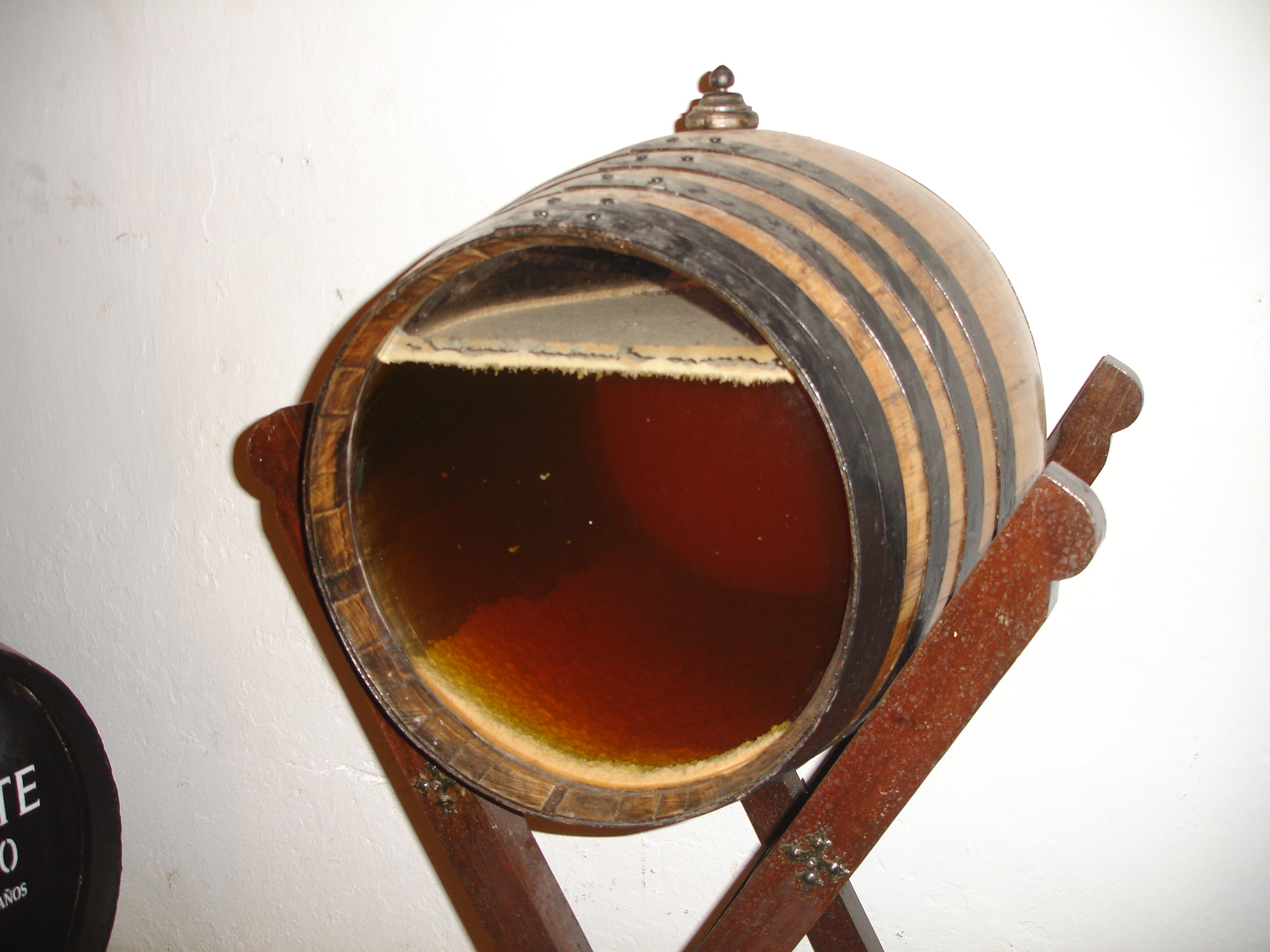
Both wines are fortified with a mixture of spirits and mature Sherry called Mitad y Mitad, both are transfered to American Oak Sherry Butts... hehe, said butts again.  Fino and Manzanilla styles undergo biologic aging, or aging with flor present (See the white bacterial cells floating on the wine in the barrel picture above).  Oloroso Sherry undergoes oxidative aging.

The Flor is at the heart of Sherry making, and ultimately determines weather the wine becomes Fino Sherry or in the worst case vinegar.  Flor means flower, and in most wine making processes, unwanted organisms ruin wine.  In this case, the Flor is a special yeast that comes and stabilizes the glycerin, alcohol and volatile acids in the wine.  Flor requires contact with the air, and so it forms a film on the top of the wine that is thick in the spring and fall but thins and greys in the summer and winter.  In the past flor was a mystery, now makers have a bit more of a hand in determining the wine's fate.  Finos are produced largely from albariza soils and come from the primera yema, whild Olorosos are produce in other soils or come from the segunda yema must.

There are many classifications of Sherry.  Palma is a fine delicate Sherry in which the Flor has done well at protecting from oxidation.  Palma Cortada is a more robust fino, palo cortado is a rarity.  Flor is present, but it also gets an oxidative path.  At a certain point the flor will be destroyed on purpose by the cellar master and brought to 17 percent destroying the flor, and allowing for oxidative aging.  Raya comes from a fino with a poor flor, further fortification occurs and the wine emerges as a Oloroso.  Dos Rayas the for has disappeared but it becomes rough and coarse with high levels of VA.  Often these wines become Sherry Vinegar.


Sherry is aged in a Solera (Left).  In this system, a third of the wine is removed from the bottom row to be bottled,  The wine from the second row (First Criadera or Nursary) then fills the first row, leaving them a third empty.  The wine from the second Criadera then replaces the wine from the second.  New wine then replaces the wine removed from the top row.  In many cases, there has been a mix of wines in this system for hundreds of years.  Again, a romantic notion.  New wine is constantly mixed with old wine which has been a part of the system forever.

I should mention that sherry comes in many levels of sweetness from bone dry to Pedro Ximenez made from rasinated grapes.  this is a sweet dark wine made only from PX grapes aged in the sun, fortified, and then aged in solera.  It is cloyingly sweet, but balanced with acid making it a fantastic after dinner wine.

Madera wines are made in the Madeira Islands off the coast of Africa.  the islands are pare of portugal, so you can think of this as an Oreo cookie blog with two Portugese wines as cookies and a Cream Sherry filling from Spain.  the islands have a warm climate with high humidity.  Madeira wines were exceedingly popular in the 17th and 18th century and once again it was the British at the center of its popularity.

In the 18th century, brandy was again added to the wine as a means of protecting it on ships.  The East India Trading Company became the biggest distributor picking up pipes of Madeira and shipping it across the ocean.  they soon realized that the act of shipping actually improved the wine.  This was due to two factors.  First, the heat, and second the motion of the ocean.

Most of the island is volcanic and they grow many grape varieties.Bual, Verdelho Malmsey and Sercial must be at least 85% of the grape mix, but they may also contain Bastardo, Moscatel, Terrantex, and Tinta Negra Mole (For cooking).

The grapes are fermented either in Stainless or in wood.  In sweeter wines, the grapes (Bual and Malvasia) are fermented on their skins to extract phenols (A bitter compound) to balance the sweetness.  Dry wines are made from Sercial, Verdelho and Tinta Negra Mole are separated from their skins prior to fermentation.

Madeira is special and different because of how it is aged.  It is aged in hot and oxidative conditions.  There are 3 methods for doing this.  The first is the cheapest method called Cuba de Calor.  The wine is put in SS tanks and heated with piping or coils that allows hot water to circulate.  the wine is heated for a minimum of 90 days to temperatures as high as 130 degrees.  Sometimes the wine caramelizes leading to a burnt and bitter flavor.  After the heating in the "Estufa" the wine is allowed to cool and rest for 3 months, and then it is transferred to wooden barrels for aging.

The second method is the Armazen de Calor Estufagem.  In this method, the wine is placed in wooden cask in a room like a sauna.  Steam heats the room and gently exposes the wine to heat.  The wine is then allowed to cool for 3 months (Estagio) and then transferred to wooden casks to be aged.

The best method is the Canteiro Estufagem method.  The casks are aged in the sun (See picture above).  the beam they are resting on is called the canteiro.  These wines are far more fruity then wines of other methods namely because they do not caramelize.   However, the heating process takes a lot longer.  For every 3 months in estufa, the canteiro method requires 5 years to obtain the same results.  By this method, heating may take anywhere from 20 to 100 years.  Therefore patience is a virtue.

Madeira must have at least 85% noble grape, and be aged for a long time.  Riserve must be aged a min of 5 years, Special Reserve 10 years and be without artificial heat, extra reserve over 15 years, colheita or harvest will indicate the year of harvest and must say Colheita on the label, Frasqueria or vintage must be aged 20 years.  There is one last style that is worth mentioning called rainwater.  This is a lighter style usually served before a meal made from verdelho or Tinta Negra Mole in which water is added after vinification and aging.

Thursday, April 2, 2015

Spain


SPAIN

Vitis vinifera is the species of grapes that the best wines are made from.  They have been in Spain so long, it is believed that they pre-dated people.  So, unlike many of the places we have discussed in this blog, many of the grapes in Spain, are from Spain.  These vines have been in Spain for over a million years.  It is therefore no surprise that Spain has the largest acreage of planted vineyards in the world, and ranks 3rd in total production behind only Italy and France.  Again NO SURPRISE.  The people of Spain tend to party like rock stars.

Spain got passed around by civilizations kind of like (to stay with a theme) a groupie at a rock concert.  The Phoenicians, the Romans, the Moors (Not to be confused with the Moops).  I will stop here to say that as Muslims, the Moors were conflicted about the grapes due to the religious stance of not drinking, and all that saved the vines were the grapes that were eatable for the soldiers on their marches, oh, and the money that the wine was able to bring back to Spain.

In 1492 Columbus went to the new world, and with him came the wine trade.  Particularly Sherry and likely a very oxidized and strong wine went to the new world for trade.  The English also liked the Spanish wines, and particularly the Sherry until the Spanish defeated the English in the Armada of 1588.  this is proof once again that if you are in sales, and you take a client golfing, sometimes it is a good idea to let him win.  After the Armada, the English tended to buy far less Spanish wines.

The next major event, in the face of declining quality, or more specifically the quality of the other European wines getting better, came in the 1850s.  It came in the form of a little aphid called Phyloxera which struck France, leaving the French with no wine to make.  After all, the best wines are made from grapes according to the French, and they had none.  They therefore came to Spain looking for some of their grapes.  The Bordeaux winemakers trained the Spanish, and quality quickly improved.  It is also why Rioja uses many techniques from the Bordeaux region including aging in Bariques.  The one caveat is that the Spanish tend to use American barrels.  Unfortunately, Spain also got hit with Phyloxera in the early 1900s.  this followed by the Franco government, and trade with Spain plummeted.  After Franco's death in 1975 however, there was a revival.  Miguel Torres used the first Stainless tanks which allowed the Spanish winemakers to control the amount of oak.  The wine laws came into play in the 70s, and Spanish wines were challenged by more modern techniques.  Today, they are some of the best values in the wine industry.  I like them a lot, and drink my fair share of them.

The DO laws were finalized in 1972.  DO stands for Denominacion de Orgen.  Each DO has a police officer of wine (Consejo Regulador) to ensure the wine makers are doing what they are supposed to.  The agency responsible for the reguladores is the INDO (Instituto Nacional de Denominaciones de Origen).  

Spanish wines fall into 5 categories ranging from table wine (VDIT), VCIG, DO, DOC, and finally DO PAGO for the best single vineyard wines in Spain.  As of 2003 there were 15 DO Pago wines in all of Spain.  This was an attempt to classify vineyards of highest quality, like their friends in Bordeaux.  These include Marquis de Grinon, Guijoso, Arinzano, Otazu, and Pago Ayles to name a few.

Wines can be Joven (Less than 12 months in oak), Crianza (6 monts in oak and 2 years aging in a bottle (In Rioja it requires a year in oak, plus one in a bottle), Reserva (3 years aged with one in a barrel.  Whites and Roses must have 2 years aged and 6 months in oak), and Gran Reserva which requires 5 years of age with 18 months in barrel (24 months for Rioja).  Even Gran Reserva whites and Roses must be aged 4 years with 6 months in oak.

You will also see a new aging system with Noble (18 months),  Anejo (24 months) and Viejo (36 months).

Spain sits on a massive plateau known as the Meseta.  The climate has influences from both the Mediterranean and the Atlantic with the Eastern side being cooler, and typically making better wines.  Most of Spain is in a rain shadow so it is dry (Except for in Galicia).  Due to hot summers, the best vineyards of Spain are at higher elevations.  There are also rivers throughout Spain.  The Ebro, from whence comes the name of the Iberian Peninsula, the Duero, the Tajo, the Guadiana, and the Guadalquivir are the most important for the growing of wine.

Spain's weather make things like Mildew rare.  There is also a low yeild due to the dry climate as well as the poor soils.  As a result, vines are generally spaced at least 8 feet apart, making the yields low.  This explains why Spain is 1st in vineyard acreage, but only 3rd in production.

Be careful when buying a Spanish wines because the traditional wines of Spain are exposed to a very Oxidative process and can therefore be an acquired taste.  The more modern wines are more commercial, and tend to be more fruit forward due to the adoption of new technologies, and the use of Stainless tanks.

There are over 600 grape varieties in Spain.  DON'T WORRY, I will not cover them all.  Some worth noting are Albarino (White) Granacha, Godello, Temmpranillo, Viura (Same as Macabeo- White), and Malvasa, and Airen (most planted in Spain-White) to name a few.

Ysios in Rioja
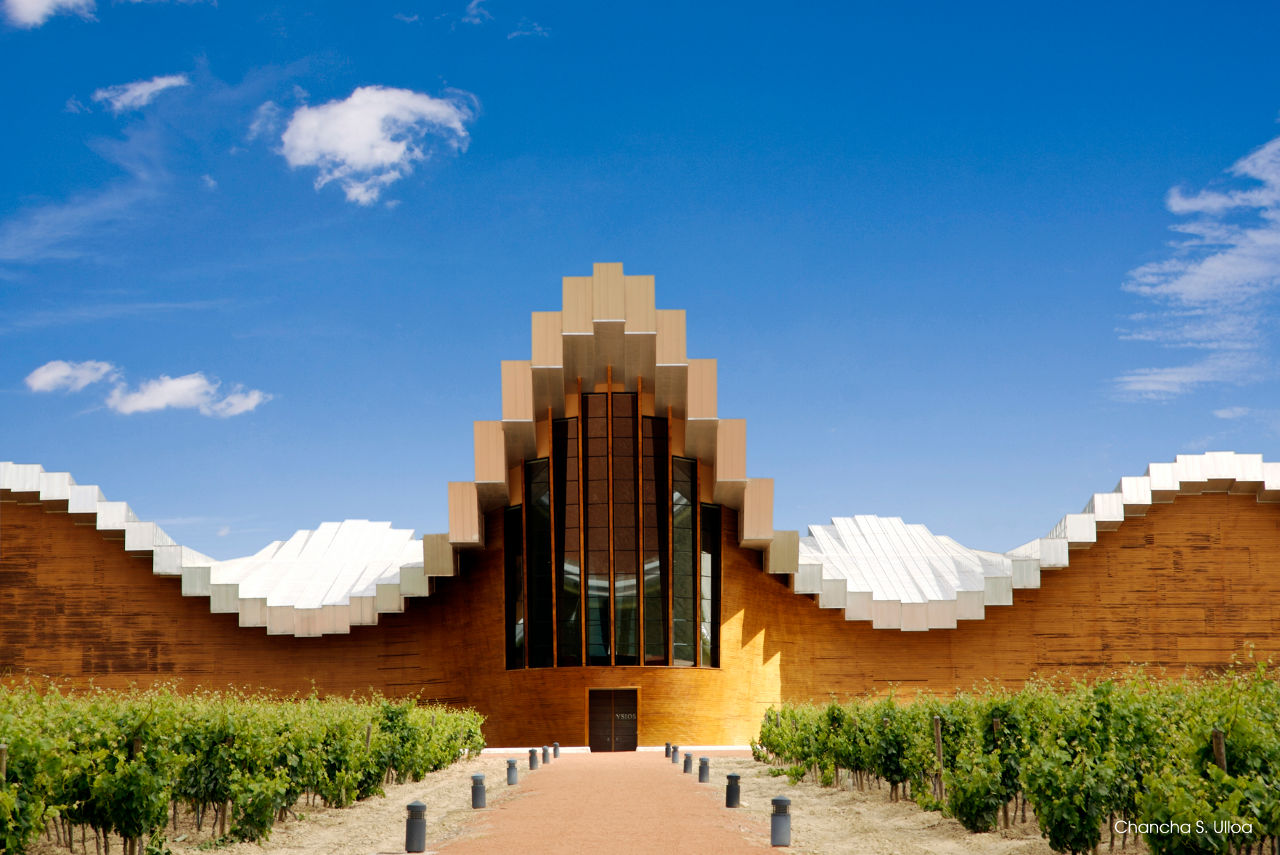
The most important region in Spain is Rioja.  It is broken into 3 sub-regions Rioja Alta (Most age worthy), Rioja Alavesa (Vino Joven), and the Rioja Baja (Mostly Garnacha).  Grapes from the Baja tend towards Garnacha, but the main grape of the region is Tempranillo.  Others include Mazuelo (Carignan), and Graciano, and Maturana Tinta.  85% of Rioja must come from these grape varieties.  Other grapes like Monastel or Cabernet can make up the remainder.  Viura (Macabeo) is the dominant white grape followed by Garnacha blanca, Malvasia and Maturana blanca.   Chadonnay, Sauv Blanc, and verdejo may be used as well but must make up less than 49% of the blend.  Rosado (Rose) wines are also made and must contain at least 25% red grapes. Generally wines from Rioja source grapes from the Alta, the Alavesa and the Baja for their blends.  Lopez de Heredia produces single vineyard wines from his Bosconia and Tondonia vineyards.  Ysios does the same.

Navarra produces similar style wines to Rioja from Tempranillo and others, but uses far more grape varieties in its blends.

Autonomia of Aragon is more of a Garnacha region.  As is Campo de Borja, and Calatayud.

Carinena is also in the Ebro valley.  The area gets its name from the grape called Carinena.  Garnacha, Tempranillo and Carinena reign supreme here.  Viura is the main white grape.

Somontano uses grapes like Alcanon (White) and Parraleta (Red) along with other international varieties.

Galicia and the Basque Country in the North is our next stop.  Perhaps the most important part of this region is Rias Baixas where they make a white wine from Albarino.  This wine is 100% Albarino unlike others that are blend.  This wine has stone fruit, citrus flowers, and sometimes has the suggestion of bubble gum.  Also, many of these wines have a salinity to the finish.  Ribeiro is known for whites made with Treixadura, a red is made with Caino, and a dried wine is made called Vino Tostado which is a lot like vin santo in Italy.

Ribeira Sacra or the Sacred Bank, so named because of its concentration of churches has pitched vineyards that hug the river.  This region makes a nice red wine from Mencia grapes and whites from Treixadura and Godello.

Valdeoras and Monterrei are small regions with Valdeoras making a very clean fruit-driven white from Godello that is high in acid and great for food.

The Basque country can be summed up by saying the words are hard to pronounce, and I am not even sure how to pronounce them even when they are written out.  There are 3 DO zones.  Getariako Txakolina, Bizkaiko Txakolina, and Arabako Txakolina.  They produce white, red and roses.  Ondarrabi Zuri makes the best whies and the majority of wines in the region.  Ondarrabi Beltza makes the best reds and the rare roses known as Ojo de Gallo are made as blend from the two grapes above.

Castilla y Leon is most known for the Ribera del Duero.  Other DOs of the area include Arlanza, Cigales, Rueda, ToroTierra del vino de Zamora, Arribes, Tierra de Leon, and Bierzo.  Castilla y Leon is located between the Atlantic and Mediterranean but still sees extreme high temps and low temps.

Bierzo DO and Tierra de Leon DO makes great use of the Mencia grape.  It must be present in a minimum of 70% of the reds of the regions, and 50% of the roses.  Many of the wines are made from 100% Mencia, and due to top producers some are getting top dollar.  Whites are also made here from Godello and Dona Blanca.  Palomino is still the most frequent grape grown.  Another grape that grows in the area is the Prieto Picudo which produces high acid, high tannin wines that are very cellar worthy.

Ribera Del Duero DO, Tinto del Pais (Tempranillo) gets planted with Bordeaux varieties and even Pinot Noir.  Vega Sicilia has long been the most influential maker in the region, but others like Pesquera, Pingus, and Aalto make great wines as well.  In 1982 Ribera del Duero achieved its DO status, and it had only 9 producers.  Today there are nearly 300.  Only reds and a few Rosados are made here.  Tempranillo is the main grape.  Crianza wines must age 2 years with one in cask, Teserva must age 3 years with 1 in cask, Gran reserva wines must age for 2 years in cask and 3 in the bottle for a total of 5 years.The best wines of the Ribera del can be very expensive and frequently go for hundreds of dollars.

Rueda produces whites from Verdejo, which is prone to oxidation, but with the right technique produces a beautiful aromatic wine.  Sparkeling and reds are also made in Rueda.

Toro is responsible for the anatomically correct, non neutered bulls all over the Spanish countryside.  They are made from Tinto de Toro (75%), a local strain of Tempranillo.  They also produce whites from Verdejo and Malvasia, and rosados.

Tierra del vino de Zamora DO produces all three colors as well with reds coming largely from Tempranillo,  They benefit from proximity to Rib del Duero, but are generally not nearly as good.

Cigales DO produces reds from Granacha Tinta and Tinto del Pais (85% combined) but is noted for its rosado and nuevo rosado.

Arlanza DO is a DO that got its designation in 2007.  Here both Duero valley varieties as well as those from Bordeaux go into the blends.

Catalonia has  10 DOs.  The most important of these is Priorat.  Priorat DOCa is in the Southwest of Catalonia.  Rene Barbier came to the region  to produce a new kind of wine after working in Burgundy and neighboring Spanish regions.  Granacha and Carinena are the traditional grapes.  The yields here are particularly low due to the poor soils.  The best vineyards have Llicorella soils which is very dark black slate.  They require the vines to dig down for water.  There are 12 villages of note in Priorate.  They are Bellmunt del Priorat, Gratallops, El Lloar, Masos de Falset, La Morena de Montsant, Poboleda, Porrera, Scala Dei, Les Solanes, del Molar, Torroja del Priorat, La Vilella Alta, La Vilella Baixa.

Montsant surrounds Priorat and produces wines from Garnacha and Carinena.  These wines are a value alternative to Priorat as the prices continue to rise.

Tarragona DO makes Cava and communion wines.

Terra Alta, Concao de Barbera, Costers del Segre and Pendes also make wines in the Catalan.DO

Also of note, CAVA can be made anywhere in Spain and is the spanish version of Champagne.  Not really though, because it is refreshing and cheap.  Grab a bottle of Cristalino Cava for 10-20 dollars and you will have a great drink.  Basic Cava is aged 9 months, Reserva 15 and Gran reserva 30 months.  None of that really matters though.  The wine is plain refreshing.

In the South, Jumilla, Yecla, Bullas, Valencia, Alicante, Utiel-Requena, and others make wine as well.  Of those, I will just briefly cover Jumilla, Yecla and Bullas where wine is made in sandy soils that resisted Phylloxera until the 1980s.  This allowed a renewed focus on quality.  Monastrell is the grape in this region.  Thick-skinned and drought resistant this is the perfect grape for the region.

There are many other places in the South of Spain, but I will not cover them here.  The one last note I will make is Sherry is the South's greatest contribution, but I will cover that in another discussion.

I will end the same way I began, by saying that some of the best deals in the wine biz can be found in Spanish wines.  For 20-30 dollars you will find high quality wines.  Spend a bit more, and you will find wines that are incredible.  This is a part of the world worth looking into.  I suggest you do.


Saturday, March 28, 2015

Southern Italy

Southern Italy

Well, any class that starts with the words, "What can I say about the wines of Southern Italy?"  Pthhhh! With parsed lips and spit in a French accent... Did not think the class would be worthy of my time, but... I have had southern Italian wines that are enjoyable, and the value is certainly there.  If I have learned anything about wine since starting these classes, it is sometimes you get surprised.  Sometimes you anticipate liking something because of the label, where it is grown, the grape variety, or any host of other indicators including the price you paid for the bottle.  Yep I said it, the price is a big indicator of quality bias, and we can't escape it.  What you find in the bottle however is flat and uninteresting.  The flip can be true too.  You can anticipate a lackluster wine, and find that it is fantastic.  

This has nothing at all to do with Italy, so bear with me.  Last week I attended a Pinot Noir convention in Chicago called Pinot Days.  I went because I don't always love Pinot Noir, and I wanted to find some that I liked that were not Burgundian in price (If you know what I mean).  We tried wines from California, up and down the coast.  We tried wines from Washington state and from Oregon.  There was even a table with wines of New Zealand, any of which should by all accounts make some good Pinot.  To my surprise, the wine of the day for me was from a well known wine producing area... Ontario Canada.  The winery  Vieni, (There is the Italian piece of this) makes many wines including two Pinots.  the best of which was a Reserve wine that was Burgundy for a fraction of the price.  And why not, it was a cold weather Pinot.  Some years they ripen well, others not so much, but the wine maker and I talked about how 2011 was a bellwether year.  SURPRISE!!!

To say all of southern Italy produces wines that are great would be a lie, and to say Pthhhh is equally a lie.  Wine is wonderful because it is always surprising.  There is always something to be learned, and there is always something, when you least expect it that is going to blow you away.  For me, Vieni Pinot Noir was that wine.  I will have a case please...

Back to Italy,  The history of the south of Italy and wine goes back to ancient people, and wine has been made in Southern Italy.  In fact the ancient Greeks used to call Italy's Heel the land of wine (Oenotria).  So wine has been made here for centuries.

The southern part of Italy has 10 major wine regions.  Starting with Umbria in the north and heading South to Abruzzi, Molise, Puglia (The heal of the boot), Basilicata (The arch), Calabria (The Toe), Sicily, Sardinia, Campania and finally Lazzio.

Umbria has 2 DOCGs both make red wines.  Sangrantino di Montefalco and Torgiano Rosso Riserva.  They also are famous for a white wine called Orvieto that can be served both dry and sweet.  

Sagrantino di Montefalco DOCG, considered the best wine of Umbria, is made from a grape called Sagrantino and must contain 13% abv.  Secco (DRY) with the Vigna indication must have 13.5% and Passito (Sweet) must have 18% and 80-180g/l sugar making this a whopping dessert wine.  Secco and Passito must be aged a min of 30 months prior to release.  This grape was almost extinct but is now grown in Tuscany, Sicily, California and Austrailia.

Torgiano Rosso Riserva DOCG is made from a minimum of 70% Sangiovese.  It must have 12.5% abv min and must be aged a min of 3 years with at least 6 mo in a bottle.  This is a relatively new DOCG and has only been established since 1990.  While less prestigious, this wine is more popular than Sangrantino.

Perhaps the best know in the Umbria region is Orvieto a blended wine with Trebbiano and Verdello with 15-25% Grechetto.  Recently more modern renditions may have Chardonnay, Savignon blanc and Pinot Gris or Pinot Blanco.  This wine has a long history of praise by many including popes and royalty.  Although Orvieto is a DOC and not DOCG, its popularity as a white wine from the region has continued to grow.  It comes in a dry, Abboccato and Amabile version with the latter two being sweet and usually served as a dessert wine.

Abruzzo has only one DOCG but also has 4 DOCs worth noting.  With the region being both hilly and mountainous, it is a great region for growing grapes.  The two best of the region are Montepulciano and Trebbiano.  The region also produces some high yield, low quality grapes for blending making it Italy's largest producer by volume.  One thing of note, and this is one that trips me up ALL THE TIME, there is a town, Vino Nobile de Montepulciano, and in this case a grape called Montepulciano de Abruzzo.  This one is the grape... CONFUSION!!!!!

The Montepulciano grape is named after the Tuscan region of Montepulciano in Sienna.  However, the grape is probably more likely from Abruzzo.  These are deeply colored wines with ripe and BIG tannins.  The same grape is also used for Rosso Conero DOC in Marche, Rosso Piceno, and in Offida wines.Montepulciano d'Abruzzo uses the grape it is named for but may contain up to 15% Sangiovese.  It is often described as rustic with pepper and spice abundant.

Cersuolo is a rose from Montepulciano d'Abruzzo.  the word means cherry red, and it is a deep pink despite limited skin contact.  Many find this wine interesting due to the flavors of orange peel, cinnamon, strawberries and dried cherries.

Molise has 4 DOCs Biferno, Molise, Pentro d'Isernia, and Tintilia del Molise (Red).  This is an overlooked region, but new technology and a focus on wine production techniques could make this an up and coming region.  Molise DOC.  Molise produces many grape varieties including Aglianico, Cab Sauv, Chardonnay, Falanghina, Greco Bianco, Moscato, Pinot Bianco, and others.  The geographical gifts that have been bestowed on the region should have it making exceptional wines, but until now, those gifts have not translated into most bottles from the region. 

Aglianico, pictured at left, is a grape that was rumored to come from Greece, however more evidence points to its origins being in Italy.  this is a grape that has grown in popularity due to its easy pairing with food and fantastic aging potential.  This is due to its firm full tannin structure, and its high acidity.  Despite the picture, this is a red grape that pairs well with meat.

Pentro d'Isernia is made in a red and pink variety.  The grapes are Montepulciano and sangiovese with a max of 10% other.

Biferno can come in red, pink and white.  Red and Rose are blends of Montepulciano (60-70%) with 15-20% trebbiano, anglianico and others.  they must have 11.5 abv or higher.  The whites are made mostly from Trebbiano, with Bombino Bianco and Malvasia Bianco.  they must have a min of 10.5% abv.

Puglia has 4 DOCGs.  They are Castel del Monte Bombino Nero Rosato, Castel del Monte nero di Troia Riserva, Castel del Monte Rosso Riserva and Primitivo di Manduria Dolce Naturale.  This region makes the best Italian Rose wines in Castel del Monte.  You will also see a shift to more warm weather grapes like Zinfandel (Primitivo).  This is a region in transition.  Traditionally they have made alcohol heavy wines with high production.  They are currently re-tooling to focus on quality.  Puglia has 25 DOC regions, but only 2% of the wine produced is DOC.Northern Puglia produces dry white wines that are medium bodied, fruity and have high acidity and a beautiful bouquet. Most of the whites come from Verdeca although others may be used as well. (Bianco d'Alessano, Malvasia, Trebbiano, and Bombino Bianco) Reds are made from local varieties like Uva di Troia, Bombino Nero,  Montepulciano and Sangiovese.  The only region with any international presence is Castel Del Monte in the North.

Castel del Monte Bombino Nero DOCG produces a rose from a min 90% Bombino Nero.  It may also contain other grapes and must contain 12%abv. Castel del Monte Nero di Troia Riserva DOCG must have a min of 90% Nero di Troia and 10 percent max of other grapes.  It must have alt least 13% abv, a max Risidual sugar content of 10g/l making it potentially off dry, and must spend 2 years aging with at least one year in wood.  Castel del Monte Rosso Riserva is made from 65% min Nero di Troia grape.  It must have at least 13%abv and must spend 2 years aging with 1 in wood.  It also can have up to 10g/l sugar.

Primitivo di Manduria Dolce Naturale DOCG is a high alcohol (16% abv) wine with at least 50g/l sugar.  This is a sweet wine made from Primitivo which is the same grape as Zins are mad from in California.  Many times the grapes are dried to increase the sugar content.

The south of Puglia is the heel of the boot.  It is a hot area with a cooling effect from the sea.The best grape in Puglia is Negroamaro (means dark and bitter) which may be related to Sangiovese.  These wines are rustic with earthy bitterness.  often these wines are blended with Malvasia Nera. 

Basilicata is the arch of the boot and has 3 regions worthy of discussion.  Aglianico del Vulture DOC, Aglianico del Bulture Superiore DOCG, and Grottino di Roccanova Doc.  They also make sweet wines form Moscato and Malvasia.

Aglianico comes from the name Hellenico meaning from the Greeks, but the vine may actually be local as I mentioned above.  Pronounced Ahl-yah-nee-koh, produces a robust red wine with deep color that is most certainly age worthy.  Grown in volcanic soil, it is at its best.  The Aglianico del vulture Superiore DOCG requires 100% Aglianico grapes, 13.5% abv, and superiore must be aged 12 months in wood and an additional 12 in bottles.  Riserva wines require 2 years in wood and 2 in bottles.  Additionally Malvasia and Moscato are made in the region to make sweet wine similar to VDN in France.

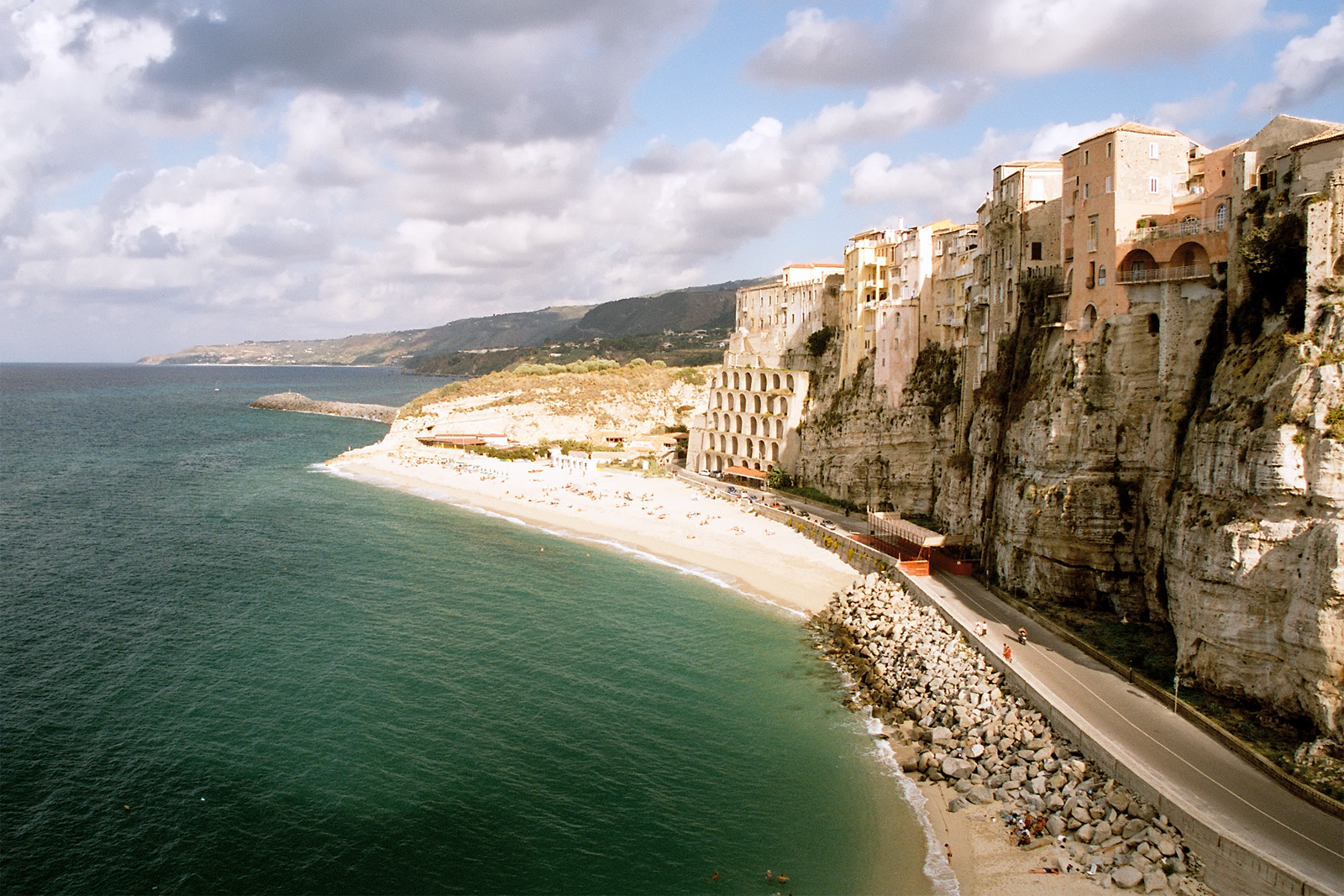
Calabria is the toe of the boot, and very popular right now for its chili peppers.  One can't eat at a fine restaurant without something served with the sweet hot little red peppers.  Unfortunately, the wine and the cuisine have not gelled.  Calabria has 12 DOCs but not a single DOCG.  The  most popular is Ciro, which maeks white, red and pink wines.  Ciro clasico risirva (Gaglioppo Grape) is a red that can age for over ten years.  It has dusty tannins, and is often described smelling like roses.   The rose is best drunk young, and the white, made from the Greco grape is fresh and pairs well with seafood.  A sweet white is also made from the Bianco grape called Greco di Bianco.


Sicily has 1 DOCG and 23 DOCs.  they are also known for Marsala wine which while in the US is largely known for cheap cooking wine, they can be fantastic after dinner drinks.  Cerasuolo di Vittoria DOCG makes two reds, Cerasuolo di Vittoria and a classico version of the same.  These wines are made from 50-70 percent Nero d' Avola grapes and rounded out with Frappato.  they have a min of 13% abv, and the vittoria may not be sold until Jun1 after harvest, with the Riserva requiring a hold until march of the following year.  This is another area that promises to produce FANTASTIC wines as there is a shift from quantity to quality.  These are wines that are popping up on a lot of wine lists due to the value that they represent.

Marsala is also making a resurgence with people in the know favoring the Marsala Vergine, ad Superiore Riserva varieties.

Mero d'Avola is Sicily's most planted grape.  It produces wines with plum and chocolate charachter with high tannin and a medium acidity.

Sardinia, the South's other island produces Vermentino di Gallura DOCG.  The wine making history has been influenced by many a traveler with Spain taking the lead role.  Moscato and Malvasia clones as well as many varieties only found in italy such as Giro, Cannonau, Nuragus, Monica, Semidano, Torbato and Vernaccia di Oristano.Vermintino dominates the whites produced most notably in Vermention di Gallura DOCG.  The wines of this region must be 95% or more Vermentino.  This wine is also grown in Tuscany and other parts of Italy as well.  At its best, it is dry, medium body and fruity showing apple, stone fruit, herbs and rocky minerals.

Vernaccia di Oristano is another distinctive wine from the island.  It is made in chestnut vats for 3 to four years with O2 hitting the wine.  The vats are not topped off creating (a Flor) beneficial yeasts to develop.  This creates a musty and nutty flavor and smell.  This wine is not to dissimilar to Sherry.  

Nuragus is the most popular white.  It is one of the oldest varieties in the region.  It makes dry crisp bright whites that should be enjoyed YOUNG.

Reds made on the island are Cannonau (Related to Grenache, and Carignano and Monica are also of Spanish origin.  Cannonau can also be made into a fortified wine similar to Port.

Campania has 4 DOCGs.  Aglianico del Taburno, Fiano di Avellino, Greco di Tufo, and Taurasi represent the best of the region.  Falerno del Massico Bianco are made from an ancient vine called Greco, while the Roso is made from Aglianico and Piedirosso.  Sometimes wine makers will add primitivo and Barbera.  

Aglianico del Taburno must use a min of 85% Aglianico.  there are Rosatos and reds with 12% abv required and a Riserva requiring 13%.  Rosso must be aged 2 years, Riserva 3 years with at least 1 in oak, and 6 in the bottle.

Taurasi DOCG is also based on Aglianico.  It must be aged 3 years with 1 being on wood.  if labled Riserva it must be aged 4 years.

Greco di Tufo DOCG is made with at least 85% Greco (White).  It is very zippy and fresh with a rocky mineral finish.

Fiano di Avellino DOCG is a rich, WAXY, strongly flavored white wine.  There are sweet wines made in the region, but a dry version sells internationally.  It features toasted Hazelnuts in its nose.

Lazio has 3 DOCGs Cannellino di Frascati, Cesanese del Piglio (Sometimes just Piglio) and Frascati Superiore.    

Cannellino is made form 70% Malvasia Bianca di Candia and or Malvasia del Lazio and 30% others from the region.  These wines must have 12.5% abv and a min RS of 35g/l (So they are mildly sweet).

Piglio mades a red from Cesanese di Affile and or Cesanese Comune.  Min abv must be 12% in the standard, 13% in the superiore, and 14 percent in the riserva.  Riserva is aged 20 months, Superiore cannot be sold for a year and the normal wine can be sold 5 months post harvest.

Frascati Superiore DOCG makes white wines form Malvasia with up to 30 percent coming from other local sources.  Superiore must have 12% abv, and the Riserva must have 13.  Riserva must be aged a year including at least 3 months in the bottle.

Next week we will talk about Spain, minus Sherry.  Thanks.


Friday, March 20, 2015

Central Italy/Toscana


Central Italy/Tuscany

Perhaps one of the most fantastic vacations I have had the pleasure of going on in my lifetime was a trip to Florence, and a stay in Radda in Chianti.  We stayed in an old manner house in a medieval town.  The town was nestled into the hills, and the words, "Go straight" to a driver had no real meaning.  Way up in the mountains, overlooking the valley below.  The sun casting shadows from the few clouds that floated bye.  Tuscany is beauty.  It is the birthplace of the art world as we know it today, it is home to some of the most beautiful and simple food that the world has to offer, and it is the home to some of the best olive oil and vinegar (Aged Balsamic).  It is also the home to Chianti Classico.  To understand Italy, and it's people, one must simply sit in a wine bar, or a enoteca (wine cafe) with a glass of Chianti, some bread, and a plate of food (Whatever they suggest that day).  Food is Italy, and food is never served without wine.  A meal without wine in Italy is called breakfast, and I really do mean that.

Radda in Chianti
On day 3 of our trip, after buying some expensive bottles of wine, a very nice server walked over to our table, and said, "you know, you don't have to do that."  Do what? said we.  She said, "Buy expensive wines in Italy."  Why?  The local "house wines" were fantastic, and at 12 Euros a bottle, much less expensive than the stuff we were ordering.  It is what the locals drink, and it was great.  They were proud to display it, and proud to serve it, and we were all too happy to drink it.

So, lets talk about the wines of Tuscany shall we?  One cannot discuss Tuscany without Sangiovese, a grape that is so elegant, and yet so misunderstood.  Why?  Because it used to be served in America as Chianti,  in a bottle called a Fiasco.  These are the bell bottom bottles with wicker baskets on them.  The wine in Fiascos is NEVER good, and thus, that was the thought of Chianti in the United States.  Too bad really, because Chianti is great, and Sangiovese is the grape that makes it so. 

There are 11 DOCGs in Tuscany including Chianti Classico.  The other red DOCG that gets a lot of street cred in the world market is Brunello di Montalcino DOCG (Thought to be among the best wines in the world), Carmignano, Chianti (Note that all Chiantis are not Chianti Classico), Elba Aleatico Passito, Montecucco Sangiovese, Morellino di Scansano, Rosso della Val di Cornia, Suvereto, Vernaccia di San Gimigano, and Vino Nobile di Montepulciano ( A beautifully rustic red).

Brunello di Montalcino wines are made from 100% of a clone of Sangiovese called Brunello, and must be grown in the Montalcino region.  Brunello must be aged a minimum of 2 years in wood, plus another 4 months in the bottle.  They may not be sold until 5 years after the harvest on January 1.  Thus, the 2010s are just hitting the market now in 2015.  Brunello Riserva must spend a minimum of 2 years in wood plus 6 months in a bottle, and cannot be sold until 6 years following the harvest.  So the 2010s will come out next year in 2016.  Additionally, due to the long cellar times, producers of Brunello may also produce a little brother wine called Rosso di Montalcino which is less tannic and often more approachable young.  Therfore, Rosso only needs to be in the cellar for 1 year prior to release, and only 6 months needs to be in oak.  These wines are lighter and fresher and 1/3 to 1/2 the price of a Brunello.  There is good wines to be had in the Rosso category as well.

Carmignano is another Sangiovese based red that must contain at least 50% Sangiovese but also has french varieties like Cabernet Sauv and Cab Franc (Up to 20%), and a host of other grapes like Toscano, Malvasia (White) Canaiolo Bianco (White) up to 10 percent.

Chianti Classico and it's big brother Riserva are grown between Florence and Siena.  Chianti Classico used to be limited the amount of Sangiovese that they included in the blend to 80%, however, that requirement has since been lifted, and many wines are made with 100% Sangiovese.Traditional blends included white grapes like Trebbiano and Malvasia Bianco, but they are no longer alloud since 2006.  Chianti Classico must have 12% ABV, and be aged 1 year, Riserva must have 12.5% alcohol and be aged 24 months and 3 months in the bottle, and Gran Seiezione wines must be produced from estate fruit, contan 13% ABV, and aged a minimum of 3 years.

Chianti DOCG must have 70 percent or greater Sangiovese.  They are alloud up to 10 percent white grapes and no more than 15% Cabernet Sauv or Franc.  The Chianti Senesi must be greater than 75% Sangiovese, can no longer have white grapes after 2015 (Up to 10 percent until then) and no more than 10% of the cab cousins Franc and Sauv.   Depending on the region there are different ABV requirements ranging from 11.5% up to 12.5%.  All must be aged for at least a year with the Reserva being held back for at least 2 years.

DID YOU KNOW:  In days of old, Tuscany invented a technique called Governo in which they dried some grapes and held them back from the initial fermentation.  If the yeast got stuck, they would add these high sugar raisins to the must, and it would help kick-start fermentation again.  Temperature controlled tanks did away with the need for this technique, however, some winemakers still use the technique by choice, especially with grapes like Verdiccio which can be bitter.  Governo helps to counteract the natural bitterness of the grape.

Back to the program.Elba Aleatico Passito is made in Livorno.  This is made from 100% Aleatico after air drying causing a very high sugar content (30%).  The ABV must be over 19%.

Montecucco Sangiovese also makes wine with Sangiovese and must be greater than 90%.  These wines have a minimum abv of 13% with the Riserva being a min of 13.5.  They must be aged a minimum of 1 year in barrels and 4 months in a bottle, with the Riserva being aged for 24 months in oak and 6 months in a bottle.

Morellino di Scancano is produced with Cabernet... Kidding... SANGIOVESE at 85% or greater.  These wines have a min alcohol of 12.5% and the riserva at 13% Abv.  They must be aged for 1 year and the Riserva for 2.

Val di Cornia Rosso is another Sangiovese blend, but this one only requires 40%.  Minimum Abv is 12.5, and 13% for the Riserva.  It must be aged for one year, with Riserva aged for 18 months in oak and 6 months in the bottle.

Suvereto is actually made from Cabernet Sauvignon and or Merlot plus a max of 15% other red grapes.

Vernaccia di San Gimigano is a funny wine in Tuscany for two reasons.  First, it is a WHITE wine.  Second, it is a white wine grown in the most macho of places.  The town is built of Medieval skyscrapers to scare away its enemies.  This is the town that produces white wine... Irony.  Vernaccia is the grape but they do allow up to 15% other white grapes.  It must be 11.5% alcohol or 12.5% for the riserva.  This wine is aged a minimum of 11 months including at least 3 in the bottle,

Vino Nobile di Montepulciano is another Sangiovese based grape but locally it is known by the name Prugnolo Gentile.  It must contain a min of 70% Sangiovese, but can include other Tuscan grapes.  It must be aged 24 months in wood, or 18 months in wood with 6 in an alternative container, or 12 months in wood with 6 months in a bottle and the rest in an alternative container.  Riserva must be aged a min of 3 years including 6 months in the bottle.

Two other notable wines from Tuscany include Vin Santo and Super Tuscans (Which have absolutely nothing in common but that they are left to discuss)  Vin Santo, or wine of the saints, is made from partly dried grapes and aged in small wooden barrels.  It is made mainly of Malvasia and Trebbiano though some can be made from Sangiovese as well.  It is a beautiful age friendly wine often served at the end of a meal.  The flavors of almond, and orange, honey, and a bit of oxidation are always present.  It is the perfect way to finish a meal.  Frequently, the Italians have Vin Santo with Biscoti and they dunk the cookie into their wine.  It is a marriage made in Italian Heaven.

The last wine I will discuss in Tuscany is the Super Tuscan (So named by Americans)...  Tuscana wines emerged out of Italy as a revolt of sorts.  I know, wine and war should not go together, but sadly it does.  In 1970 a group lead by Sassicaia decided that they were not going to follow Italy's wine laws, which should land you in wine jail (I don't know what that is, but it sounds like a place I would enjoy).  The punishment was that these wines had to be called "Table Wines" and did not get their own DOCG.  Death to wine?  NO!!  Instead, it pushed boundaries, and produced better Italian wines garnering a price premium.  Later followed Tignanello with a blend of Sangiovese and Cabernet Sauvignon.  Today, Super Tuscans can be a blend of Cab, Merlot, Pinot Nero, and even Syrah.

Marches also sits in "Central Italy" (Pronounced Mar-Kay).  Marches has 5 DOCGs and produces 2 main grape types.  Verdicchio (White) and Rosso Piceno which is Marches for Sangiovese.  Lets start with whites.

Castelli di Jesi Verdicchio Riserva must contain 85% Verdicchio and achieve 12.5% abv.   It must be aged 18 months including 6 months in the bottle.

Conero is a red from Montepulciano but may contain up to 15% Sangiovese with a minimum abv of 12.5%  These wines are aged for a minimum of 2 years.

Offida makes both a red and white wine.  The white is made from Pecorino (or Passerina) while the  red made from Montepulciano.  The whites must have 12 percent alcohol if made with Pecorino or 11.5% abv if made with Passerina, while the reds have a min of 13 percent.  Red wines must be aged for 24 months including 12 months in wood and 3 in the bottle.

Verdicchio di Matelica Riserva is a bitter wine made from 85% Verdicchio.  It must have 12.5% abv and be aged 18 months.

Vernaccia di Serrapetrona is made from Vernaccia Nera and is a sparkling red (Rosso Spumante) and can either be dry or sweet.   It must have a minimum of 85% vernaccia Nera and 40% of the grapes must be dried.  It may not be released until June 30th the year after harvest.  It can be made both in the traditional method (Seldom, or the Charmat method.

Lacrima di Morro d' Alba is a red wine not unlike Pinot noir in its nose.  It is very aromatic and smells of Roses, boysenberry jam.  It has nice acid and  soft tannins.

This is a country full of great wines.  Try them.