Friday, September 11, 2015


CALIFORNIA WINE, AN UNDERDOG STORY

To understand why I call California wine an underdog, one needs to understand the history of the area.  The arrival of vitis vinifera, lead to excitement for California as a wine region, but as in any great underdog story, disaster followed.  Disaster in this case came in three flavors.  First, in the late 19th century, Phylloxera reared its ugly head, just like it did in Europe before.  It was devastating to the early vineyards, however.  in the case of California they were able to recover quickly.  , The European disaster suffered at the hands of Phylloxera had already occurred and the solution was well known.  Quickly, the vineyards were replace with grafted vines on native rootstock which were known to be resistant to the killer louse.  By the turn of the 20th century, there were over 300 distinct grape varieties being grown in California.  In this case, the destruction of the vineyards lead to diversification of the product offerings.

The next major event in the history of California was one that was a bit longer lived.    In 1920, prohibition hit the winemakers of California hard.  Vineyards, which were just beginning to be established were ordered to be ripped from the earth and cellars were destroyed, the contents spilled on the ground.  ( I am back.  Just needed some time to cry)  Some vineyards and wineries survived this however.  How?  They turned to God...  You see, while wine was the devils' work, if you made your wine for the church, and the wine was blessed and used for sacramental purposes, it was allowed and given an exception to the prohibition laws.  In 1933, when prohibition was repealed, there were only 140 wineries still in operation.  (Bottom lip is going again... I am OK)

The third was the great depression which lasted through much of the 1930s and made income that was disposable very hard to come by.  As you are trying to build a new industry, and the established industries around you are failing, it is not what you might call good for business.

Nevertheless, recovery did come.  It came on the backs of a group of pioneers.  People like Robert Mondavi, Joe Heitz of Heitz cellars (Illinois native in the house), and David Bruce winery, who all formed new wineries in Napa post prohibition.

Prior to the 20th century, some of the oldest wineries in California were established.  Buena Vista Winery was the first, to be bonded, then Charles Krug winery, Inglenook Winery, and Schramsberg vineyards, and Beaulieu vineyards started by a gentleman named Georges de Latour.  Latour did two smart things.  First, he hired a real winemaker by the name of Andre Tchelistcheff who had studied in Bordeaux.  This proved a great discision both for his wine, as well as for Napa Valley.  Tchelistcheff  not only made Beaulieu into a serious wine, he also helped and mentored people like Joe Heitz, Robert Mondavi, and Mike Grgich who at the time was at Chateau Montelena.  We will talk more about him when we discuss the Judgement of Paris.  These people and wineries in many ways were the pioneers of good wine in California.

Prior to these guys coming on the scene, California was content producing sweet wines from Carignan and Thompson Seedless grapes.  That is why the above deserve acclaim.  Not because they brought the idea of California as a wine region, but that they had a dream that California could compete on the national stage.  They wanted to produce wines as good as were produced in France, and they set out to do just that.

French Wine Snob
In 1976, a blind tasting was being held in Paris France.  At that time, a British wine merchant named Steven Spurrier invited several US wine makers to participate in the tasting event. and the French thought, "Hee, Hee, Hee, zee Californians sink they can make wine like Uz... Ptewy."  Little did they know, and little did Spurrier know, that The US wines would sweep both the white and the red category.  The Chardonnay that won was Chateau Montelena.  Oddly, in addition to their wine, California wines took 3 of the the top 4 spots in the white wine category.  Also notable were Chalone and Spring Mountain vineyards rating 3 and 4 respectively.

The Reds also were topped by an American wine.  Stags Leap Cabernet took the honors there.  Ridge Cellars also took number 5 in that competition.  So it was a fluke right?  I mean, it had to be a fluke... NOPE!  You guys have your french fries, and your french toast, and your fancy hats, but our wines are the real deal.  We are here to stay.  Whats that, you want a repeat?  Fine...

20 months later, the experiment was repeated in San Francisco, and guess what?  USA, USA, USA, and again in 1986, and finally, a reunion tasting for the 30th anniversary, again organized by Spurrier, and what do you think happened?  USA won again.  What was interesting here is that I hear people saying California wines won't age.  In 2006, the same wines from the same vintages were tasted as in the first Judgement, and not only did the US take the first spot, but it took the first through the fifth spots.  (And the crowd goes wild!!!!)  So to the French wine snob, what say you?  I say, wines are good from lots of places, and there is no longer a one size fits all approach to wine making.  After all, that is the edge that California has.  More on that later.

California wine sales have continued to climb and the prices have gone up with them.  The largest sellers from California have historically been Chardonnay and Cabernet Sauvignon, but that has been changing of late.  Pinot Noir on the coast has grown, along with Rhone and Italian varietals (Lead by the Rhone Rangers and the CalItals).  California also makes dessert wines, Sparkling wines, sweet wines, rose and any other type of wine you can think of.  Why?  because they can...

Like in Europe, California and the rest of the US for that matter, as an Appellation of origin system.  Called the American Viticultural Areas (AVAs). 

Unlike Europe, these are geographic markers of where the wine has come from, but there are not the same rules about what can be grown, the crop yields, etc.  We as Americans don't want anyone telling us what to do, what to grow, what to produce... Not even us.

As a result, we have a vast number of grape varieties, growing methods, tons per acre, etc.  There are no rules governing the production in many ways.  However, wines that denote a state or a county must have 75% of the grapes come from that area.  If on the bottle it mentions an AVA, then 85% must come from that location.  

Currently over 90 percent of the wine made in the US is made in California.  California currently grows over 100 varieties of grapes.  That said, 6 varietals make up the vast majority of production, Pinot Noir, Sauv blanc, merlot and Zin, and as mentioned before the king and queen, Chardonnay and Cab Sauv.

The lack of regulation seen in Europe has aloud California to blossom in a way that their European counterparts cannot.  Winemakers can be innovative, and are often of the mind that breaking rules in wine making and taking risk pushes the art forward.  The other side of that coin is that we in the US, and California in particular are still trying to figure out what is best for our wine.  Years of practice, and regulation has lead to Bordeaux for instance producing wines that are unique and unmistakably Bordeaux.  California is a mixed bag.  Big, excessive over done, high alcohol wines, and a group that is trying to allow the unique terroir of California produce what the land wants to produce.  

On a recent trip to Sta. Rita Hills, I was talking to a winemaker by the name of James Sparks.  James is the head wine guy at Liquid Farm winery.  They make amazing Chardonnay.  Not the excessive oak laden creamed corn stuff of California fame, but rather wines with a tension.  They are high in acidity, light in the mouth, and would pair well with most foods.  They have memorable long finishes, and I really cannot say enough about them  It would be wasted breath anyway.  You really need to try them. 

In talking to James, I asked him if he puts his wine through ML fermentation.  His response to me is that he does not add yeast, he does not add ML bacteria.  He is the guide, but he pretty much lets the wine do what it wants to do.  

That is the direction that California needs to head.  It is the direction that many of the young winemakers are heading, and it is an exciting time to watch the growth that will be coming as we understand what is possible in the vineyards, but also in the winery.  California has a sense of place in all that it does.  It is moving towards place in its wines as well.  I for one find that to be exciting.  It will be a time of discovery for the wine makers, as well as for the American Palate moving forward.  Hang on, it might be a bumpy ride.

The thing I want to close on here is that California, like so much of American culture, IS the underdog that got knocked down, got up, dusted itself off, and won.  What will be fun moving forward is to see how the wines of California continue to get better as other places continue to up their game.  How California adjusts to climate change, new challenges, a water shortage, and so many other issues that they face moving forward.  If the history is any indication of what the future will bring, California will lead the way in wine for years to come.


Thursday, August 27, 2015

Back in Class

So the summer is over.  I know this to be true for two reasons.  First, we are starting to get that cold air blowing in at night in Chicago, that shows that the seasons, they are a changing.  It comes on suddenly.  One week it is warm and humid by day and by night.  It is hard to sit outside as it feels as though you are sitting in a bowl of soupy air.  The next, the wind shifts and suddenly, it is cool, crisp, and a great time to sit outside in the evenings, in front of a fire pit.  We chose to grab Grams and marshmallows and make smores last night.

The second, well, school started for my kids, but also for me.  This time there are two other students in my class, and I am the only one who has completed a semester.  Last time I started, I had butterflies, this time, I am the BMOC (Big Man On Campus).  Or am I?  One of the newbies is a server in a restaurant.  He knows food and wine, and works around it day in and day out.  The other, like me is a marketer.  I sensed what he was feeling.  OVERWHELMED.  I told him that the first four or five weeks is like a whirlwind, but that things will slow down for him as the class goes on.  He seemed relived.

Today's topic, wine tasting.  Weird.  I have kind of been doing that since the beginning have I not?  It became apparent to me why it is suggested that one take new world wines first, and old world second.  It has nothing to do with the regions per se, but rather, it has to do with the up front tasting, and service related topics that one can learn prior to actually having to taste wine, which will help them to Ahem...TASTE WINE.

Today, we tasted two whites and two reds from California.  The whites were both lackluster at best, and the reds were quite good.  We followed the tasting methodology established by the Guild of Master Sommeliers.  First, you look at the wine, next you smell the wine, and finally you taste.  Along the way it is important to notice things like color, clarity, brightness and viscosity.  Next as you smell, you look for faults (Too much sulfer, overly reductive, cork taint.  Next you smell for fruit, non-fruit, and other tell tale signs of the wine.  Next you taste.  Here you are looking to confirm what you have discovered on the nose, and then to determine if you might have missed anything.  You are also determining the body of the wine, the acidity of the wine, and finally the tannins (astringent compounds that make your teeth feel funny in red wines), or phenolics in whites which are bitter.

I have done this hundreds of times.  If you don't believe me, friend me on twitter (JKAPPY) or find me on Vivino.  You can read all 500+ wines that I have prepared tasting notes on.  So I sat and thought about why we should care.  It really comes down to two reasons.  First, people need to communicate with customers (Or in my case friends) about the wines we drink, and why they should enjoy them too.  With an Albarino, you will taste stone fruit and a salinity that will pair well with the seafood you are eating..., or it is light and similar to a Sauvignon Blanc, but I think you would enjoy it more... or if you only like big reds, this one will be amazing and it is not a Cabernet, so you will be tasting something different, and still be able to enjoy your "Big Red".  None of this would be possible without establishing both a vocabulary for wine, as well as systematic way of assessing it.

The second is a parlor trick of sorts.  By systematically assessing wine, a Sommelier can taste blind and do a better job than the average person at guessing the type of grape, the region and the age of that wine.  Why is this important?  Because, as an expert, it is important that a sommelier can start to understand what is possible with place, and with grapes and to categorize things that they have tasted so that they have a catalog with which to compare wines within a category.  Oh and also, you can't get certified as a Somm unless you gain some level of proficiency at tasting blind.

In making wine so important, and elevating its status, I worry that often times we turn off people who might otherwise be interested.  Might otherwise want to be a part of the party.  So how do we find that balance?  Be able to converse, and teach, and peak interest, and not scare our guests and friends away?  How do we tell people what they should taste, without making them feel bad that they in fact can't taste it?  

Illustrative Story:  A friend walks in and I mention to them that they are going to taste a mineral driven Sauvignon Blanc by Massican (One of my favorites).  They ask, what does mineral driven mean?  My response, it tastes like licking a rock.  They might look an awful lot like the guy on the left.  How many of us have licked a rock?  I hadn't until I started this crazy Somm program and now I have licked many. (Indecently all rocks taste the same)  I have also licked seashells, and many other things to see what they taste like, but most of my friends have not.  As a result, they say, I don't taste it and get discouraged.  Have I taken some of the enjoyment out of their experience?  Do they care that it is mineral driven.  If they put too much pressure on themselves to taste those things, what does that do to the rest of the flavors.  Worse yet, has my mere suggestion of what they are to taste changed their perception of what the wine is "Supposed to taste like"?  Hmmm.

So what should matter?  For me, the tasting notes are a catalog that we should be using as internal speak to simply compare between wines.  We also may use them to communicate or teach.  For the average wine drinker however, they can be overwhelming, and suggestive.  For the average drinker, what matters at the end of the day, is what types of wines they like, how adventurous they are, and what they are planning to eat.  Our hope is to have the catalog that lets us say, "if you like that, you will likely enjoy this too because...  Or, if you are interested, I have something that tastes totally different, and might be something for you to try...Or, with that dish, I really like that this wine balances or contrasts with this food because...  I am not sure at the end of the day that the technical speak is needed.  I think one of the goals of a good Somm should be to make wine approachable, and so frequently, we do not.  It doesn't elevate an educator to make their students feel stupid, and we risk doing exactly that if we are not careful.  I know when I first started in the program, I went home often feeling like I was missing something, and today I saw that in one of my peers in the program.

My goal will be to make people feel comfortable, make them excited, geek out when they want to do so, but stay grounded when they don't.  After all, what matters at the end of the day is one thing.  It is not if there are apple flavors, or if there are pyrazines in the wine.  What matters is that our guests are in a safe learning environment, that they feel safe asking questions, that they understand at the end of the day, that the only thing that matters, is if they like what they are drinking.  It really is that simple.

Wednesday, July 8, 2015

How did I get Here?


Grape Vines Grown in my Front Yard
How Did I Get Here?

I enrolled in the second semester of Sommelier Certification at Harper College yesterday, and I must admit, I took a brief pause.  What am I doing?  Why am I doing this?  Who or what am I doing this for?  How and why are there grapes growing in my front yard...In Northbrook, IL?  Yep, they are most certainly in my front yard because the back yard does not get enough light.  We have covered that before, lest you forgot, but it is still funny.

So I pondered.  Me, a person who barley if at all remember my dad taking a sip of any alcohol let alone wine.  We grew up on screw top wines before they were in vogue.  Wines like Manaschewicz, and Mogen David.  Hardly fine wines by any stretch.  I also remember taking my first drink.  I was in college believe it or not.  I never liked the taste of beer, and never had any interest in wine.  Finally, after years of trying, beer made sense.  I liked scotch next, and then years later wine.  Wine was a drink I would have with food.  Being in grad school, it was not great wine, but I was interested.

I remembered being newly married and going out to Napa/SonomaValley on a work trip, and having my wife meet me out there.  I know it sounds romantically ridiculous, but the air smelled different.  Things slowed down, and not just because we were drunk.  The mountains, the farms, the WINE.  There was no where to be, and even if there was, we could not get there fast.  It was wonderful.

I remember some of the wineries we visited.  We were young, had no money, and are not planners, so we wandered and often wandered into large, well known wineries.  We stopped by St. Supery, Cake Bread, Kunde, Kenwood, Valley of the Moon, Rombauer,  Beringer, Coppola, Rodney Strong to name a few. These were large production wineries that made largely good product.  We also accidentally wandered into some smaller more intimate wineries.  These included Chateau Potelle (Still a favorite for many reasons) and Regusci.

At the time, Regusci was a laid back location making small production wines that can be measured in the hundreds of cases.  When you walked into their tasting room you were promptly greeted by two corgi dogs and a yellow lab.  The dogs were the fuzzy equivalent of the old men at Walmart who welcome you just to get away from their spouses for the afternoon.  Half awake, more often half asleep, excited to see you for a minute, but not enough to move.

The man behind the counter was from Wales, and had a spectacular accent.  He was pouring for us, and for a group of four to our right, bouncing back and forth, and making jokes in a rather irreverent way. That is until the man to our right said something about paying taxes so that illegals could pick their grapes, and send it back to their homeland...Less jovial, the man from Wales explained that these "illegals" do hard work, and that he should thank and praise them for doing work that wineries could not pay anyone else to do.  "And by the way" he said, "you don't pay any taxes here, you are from Utah."  

At this point one would have expected that the man would leave, but he kept going for a while.  At this point the tasting room guy says, "Isn't it funny, even great wine can taste like S%&T when you have to drink it with an A%& Hole like you.  GET OUT!"  

He then promptly came over to us and apologized profusely.  I told him that his stock went up in my book for that.  He offered us any bottle of wine in the place to share with him.  We chose a Cabernet, and he poured for all of us.  It was then that I fell in love with wine.  He told me, "You know, the opposite is true as well."  Pardon? I said.  He told me a very average bottle of wine shared with great people, or in a great moment can taste fantastic.  You will frequently remember it even more fondly than it deserves."  To this day, that remains true.  I have often had that experience remembering a great bottle, and then returning later to find that it was the moment and not the wine that made it great.

On that same trip we joined the Club at St. Supery as much because they got us drunk as anything else.  We walked the grounds looking at the sculpture gardens, and the art in the tasting room.  It took us an hour and a half to feel comfortable getting into a car.  We still have the goofy pictures to prove it.  We are still members of their reds only club, and happy to be.

Also on that same trip, we stayed at a B and B in downtown Napa.  Pouring at the happy hour was a guy named Tony with a fantastic group of wines, and an even better story.  Chateau Potelle was an estate winery off of a road called the Veeder Grade.  The winery was started by Jean Noel and his wife Margarite.  They were hired by France as Spies to look into the Napa wine-making situation in 1980, and according to them they sent a telegraph back home saying, "Looks Good, We Stay!"  They call their Reserve wines VGS (Very Good SH&T), and until recently had cougar prints on their Zin, Syrah and Chardonnay bottles to represent the need to off the deer on the mountain to protect their grapes.  They too had dogs (Opus was a puppy and recently purchased at an auction at the Opus winery).  The view of the valley from their location on the mountain was also beautiful.  We smartly brought a picnic to the winery and sat on a bench looking out at the beauty below.  Joined that wine club too and are gladly still members til this day.  We consider the team there to be friends, and their wines are more often than not what we turn to for celebration.

Napa has always felt like home.  I have never lived anywhere outside of Chicago, but when we go back, we feel at home.  Good wine, good food, great people, and good friends all make us want to be there even when we are not.

The next memorable wine trip was to Tuscany.  We had been drinking Chianti Clasico Riserva from Monsanto winery for 4 or five years.  The first time we tasted it, the bottle was purchased from gold standard liquors in Skokie, IL.  When I picked up the bottle to purchase it, largely because I thought it was funny that it was called Monsanto, I was immediately yelled at from across the store.  "YES, YES, YES!!!"  The store manager bounced over with so much excitement to tell me that in a blind taste test, that Chianti (1999) won over wines 3 times its price.  We bought a case for 12.99 a bottle.  Sad it is gone.  We had to go to the winery!

Unfortunately driving through Tuscany, while beautiful is not easy or straight forward.  We missed the turn and got to the winery hours later than we were supposed to.  We headed to another winery and hit Monsanto on the way back.  It was beautiful.  Again we were greeted by a dog, a great Pyrenees and a young woman who in broken English said may I help you?  We explained what had happened and apologized.   She told us it happens a lot, and said that while she could not give us a full tour, she would be happy to show us around.  An hour later, we had seen their tunnels, their library of wines stored in beautiful cave "lockers" behind ornate wrought iron gates.  It was a shrine to their family's life.  Wines bottled when kids were born, when people were married, and there was a story to go with every wine.  It was beautiful.  I only wish we had gotten the full tour.  It must have been amazing!  

That night we had dinner in Volpia overlooking the valley at a restaurant called La Bottega.  We ordered a bottle of Chianti Clasico Riserva.  It was amazing.  I understood the concept of a savory wine right away.  Beautiful sour cherries, earth, and almost a balsamic like flavor came through.  The wine had some VA, and was oxidized slightly, but the acid's ability to carry the rich pasta dishes, and how it made me want to take another bite and then another was something entirely new to me.  Being that it was pre 9-11 we brought home wine in our suitcases and it was all Volpaia.  It was great wine, so don't take this the wrong way, but Volpaia owes La Botega some bonus payments because the food and the view at the restaurant sells some wine.  It did for us anyway.

The next trip to highlight was to Spain, where the wines were amazing, and there was no need to spend a lot of money either.  Rioja was cheaper than water in much of the country.  While we did not get to go to a winery, we had a local bottle at all of the restaurants we visited, and were rarely if ever disappointed in what we were drinking.  Wine complimented the food, and the high acid wines matched the foods we ate perfectly.  

I have made many trips to places and paired foods with their wines.  Places like Greece, Israel, Germany, Prague, and many other places of travel.  But it was not until recently that all of this came together for me.  I traveled to Australia, which was really like coming full circle (Of the globe if nothing else).  While there I visited the Yarra Valley.  We drank a lot of good wine.  Jamsheed, Timo Meyer, Yarra Yering, and most notably Mac Forbes.  All were great, don't get me wrong, but what made Mac's Place so great was Mac and his wine maker Austin.  We walked in and Mac was chasing two young kids around the winery.  One was kicking a football and riding his bike seemingly at the same time, and the other required a nappy (diaper) change.  It was like a 3 ring circus.  

Mac Explained that because his wife was away on business, he would not be able to show us around, but that Austin was more than able.  Both of them were like kids in a candy shop excited every day by what they were doing.  You sensed that they felt lucky to be doing it.  And I felt lucky that they were able to do it and share their fantastic wines with us.  Austin took us into the basement of the winery, and shared wines from multiple barrels.  We tasted sweet and off dry Riesling, Pinot Noir, an experimental Nebbiolo, Cabernet Sauvignon.  Some were single vineyard offerings and others blends.  All were ripe and electric with a tense acidic finish.  These were daring, beautiful interesting wines.  Austin was like spider-man climbing the barrel racks for our next tasting.  Clearly OSHA does not apply in Australia.  We were there tasting for over two hours, and did not taste a single bad thing.  Also, the wine was YOUNG only having been in barrels for a couple months, so it was my first tasting of wines that young.  When we were done, we went upstairs to taste the wines from the bottles, they way they meant them to be tasted.  I was fascinated by the aging process, and what it did for these amazing wines.  Rounding edges, Smoothing sharpness, softening tannins were all words I had heard, but now I understood.

What was interesting, is that Mac owns nothing but his label.  He rents the building with all of the equipment, he buys grapes from farmers (He has a lot of say as to how they are grown), so at the end of the day, he is a guy with a big garage, making the wines that he likes to make from grapes grown near bye.  This business model repeats itself with Negociants in France, in the Santa Rita Hills, and in many places throughout the wine making world.  But Mac was the first time I had seen this model at work.

On the flight home I thought, I could do that.  Hmmm.  Can't I?  The answer really is no.  I can't.  Mac has spent a lot of time studying his craft, he has hired wine people who also know a lot about making wine.  However, I can do something like it.  I bought some vines (8 Vines).  I bought some grapes from neighboring vineyards (Lodi and Napa are close neighbors) and I have made wine.  The wine I have made from grapes is good.  Not great, but it is good.  I have learned a lot along the way, and Most importantly I have had fun.

So why am I doing this?  It goes back to Regusci.  Wine-making is an art, it is an organism, it is a social gatherer, it is enjoyment, and finally it is a memory in a bottle.  Making wine allows the winemaker to play with and create all of these things.  Ultimately, I am a person who loves the social aspect of food, and wine and the culture and memories that they together provide.  Perhaps the thought that good wine shared with great company makes the wine better.  But maybe the other is true too.  Good company with great wine makes the time spent together more interesting.  To enjoy wine tags the memory that you are creating.  It is that simple.  Many of the memories I shared in this post are 10-15 years old, and yet I remember many of the details vividly.  The more of your senses that you are able to involve in a memory, the more likely you are to recall the moment.  This is why wine is so important, and why I continue to dedicate hours of my life to the pursuit of its understanding.  I hope you are creating great and exciting memories, and that you are able to make wine, food a friends a big part of them.

Wednesday, June 24, 2015

Are You some Kind of A Wise Guy?

A Brief Tour of the Outer Coastal Plain AVA

When you think of New Jersey and wine, the picture at left is likely what you think of.  A group of people, sitting around a big table, sharing a bottle with a plate of Spaghetti with a Sugo that Nona slaved over all day long, or in one of the many Italian restaurants in the area.  There is however, more to the wine story in New Jersey than meets the eye.  THEY MAKE WINE IN NEW JERSEY!

While on the stereotype bandwagon, I thought I would stay there and tell you that when I say they make wine in New Jersey, I don't mean in Nona's Basement.  I mean there are wine growers, makers, and a whole wine drinking, tasting thing going on.  Granted, some of it is sweet fruit wine, or wine made from native or hybrid grapes and many are less than great I am sure.  However, there are also dry reds and whites from Vitis Vinifera Grapes (European Wine Grapes; Cabernet and the like).

I was only there for a brief time, and I only got to sample 3 wineries, but what I tasted was an impressive sample that has made me interested in going back and tasting more.  What made me think to taste wine in New Jersey?  This is a shout out to Wine Folly.  If you have not been to their blog you should.  They are one of my favorite sites out there, and I think Madeline Puckette is very good at making the scary wine thing very approachable.

Anyway, she did a blind tasting with 3 Somms and they tasted wines from Bordeaux and a wine from NEW JERSEY and tasted them blind to see if anyone could pick out the wine from Joisy... NOPE.  Also, all of them said the wine was good, and went further to say that it would be good if you had to pay 30 dollars or more.  Madeline even exclaimed because she liked the wine so much blind.  It was a Holy... Oh my, that is sooooooo complex type of proclamation.  And so, I had to taste this wine.

When I got to New Jersey, my first wine destination was Amalthea Cellars in Atco, NJ.  This was the winery that made the wine from Wine Folly, so I thought it only fair to start there.  Upon arriving at the winery, I was greeted promptly and courteously by Megan, a lovely young woman who was quite knowledgeable about the wines, and the area having grown up there her whole life.  She told me that she, "Is a Jersey Girl who loves the area and loves Jersey Wines."  Still Skeptical, I nodded and smiled.  She told me that they have both dry and sweet wines, but are known for their dry reds.  Indecently, other wineries in the area raved about their dry reds as well.  One person described Amalthea as, "Having the dry red wines DOWN!"  I would agree.
I opted for a tasting of the dry whites and reds.  Prior to tasting, I learned that the winery has been in South Jersey for 39 years.  The winery is owned and operated by a guy named Lou Caracciolo who started as a food scientist, and put his passion and know how into making wine.  He is very decorated in the area, but he also won a major wine competition in which his wines beat out wines from France and Napa.  All of the wines were tasted blind, and 100 experts chose his wine as the best in show.  Author George Taber dubbed this the "Judgement of New Jersey."

This had me thinking, maybe there are some good wines made in Jersey...  I then also learned that some of the grapes are grown locally, and sometimes they buy grapes from other growing regions.  Ah HA!!!!  That is it.  What I learned is that the grapes are Estate grown unless there is a green dragon on the label, and that in fact, most of what I was going to taste was from Estate grapes.  Also, the awards were mostly from estate wines.  Hmmpf.  Back to good wines in NJ.  Lets taste already!  Geesh, this is painful.  It really was not there, but to tell a good story, you have to have a build up.

First I tasted a proprietary rose' called Leda (A Tavel style from Cab Franc), and then a Traminette, a Pinot Grigio and a Chadonnay Sur Lie.  The Leda was amazingly complex and yet simple at the same time.  It had your typical strawberry nose with some peppery spice and a bit of floral aroma.  What was interesting on the palate was that it left me with some profound licorice spice.  A good start to be sure.  Next was a Traminette (First taste of this grape ever) which was amazingly floral and had a white tea spicy thing going on.  I think there may have been some botrytis that year as there was also a ginger finish.  Next was the Pinot Grigio which I would say was a bit of a patio wine.  Lemon zest, with a nice acidic tension.  It had a slight nuttiness to it as well and tasted as though it may have spent some time on lees.  Finally, the Chardonay which was a fairly classic Burgundy style Chardonay with Grapefruit, toast and a bit of a hopped herbaceousness.

So far so good.  Nothing bad, and since he is known for his reds, I am interested to get started there.  Perhaps my least favorite thing that I tasted was a Green Dragon Tavern Pinot Noir.  These grapes were from the Sonoma Coast.  It was not bad.  Light and smokey with floral notes and berries.  Just not that barrel funky, forest floor mushroom cold weather Pinot I was hoping for.  Next was a Clone 2 Cabernet Sauvignon.  This is a small berried variety of Cab, and shows accordingly.  Blackberry and Casis with a vegital note.  I was surprised by how ripe and interesting it tasted.  A similar cab quality from Napa would carry a much heftier price tag than the 22 dollars they were asking.  Next I tried a couple of Cabernet Franc options.  This was the money wine if you ask me.  Apparently the soils in the area are sandy, and I know two things about sandy soils.  First, they make good Cabernet Sauv and Franc, and second, that they tend to make wines with with a softer side (Italians say, "Hard soil gives you hard wine, and soft soils give you soft wine")  The first was a 2011 Cab franc which showed a lot of red fruit.  I got strawberry and some black cherries along with a lovely pepper finish.  Tannins were medium plus but very soft and rounded.  A great food pairing wine that would go with a lot due to its nice acid.

I also tried the 2010 Cab Franc, which I later found was one of the best vintages in the area ever.  Some say there will never be another 2010... It was that good.  This was a wine worth cellaring.  It was a red fruit heavy with cherries, plum and strawberries and of course a great white pepper finish.  The Tannins were big but balanced and the finish was amazing and very long.  All of this for 28 bucks.  I would say a great value.  I should say that I am a big fan of Cab Franc and I would also say that Cab Franc is what this area does best.

Finally, I tried the wine that Madeline had on Wine Folly.  The 2012 Europa which is an homage to Chateau Latour of Bordeaux fame. (2000 dollars a bottle for Latour).  This is a cab sauv, Franc and Merlot blend in the style of the left bank.  It had black cherries, currant, some tobacco, and a cedar smokey finish.  This was a great balanced wine, and if I tasted it blind I would have guessed old world for sure.  I agree that this is a wine that was not just good for New Jersey, it was really good wine by any standard.  at under 30 dollars, good luck finding anything measurably better.

I did try one of their sweet wines, and that was a wine called solara, which is kept in a ...Solara which is normally used to make Sherry.  In this case, they started with red wine, and made a very funky smelling dessert wine that was half port, and half sherry.  It was very complex, and I loved it.  I would suspect others would not. It had baking spice and funk, with orange peal and finishes with an unmistakable chocolate.  High acid means it is not too sweet. 

My only criticism is that some of the wines had a bit too much oak for my taste, but that is being very picky.  I am super happy that I went there, and I will be ordering wine from Amalthea soon.

The final point I will make is one that Lou makes often and that is if you flip NJ over, the shape looks a lot like Bordeaux.  The soils are similar as well.  It is no surprise that the wines that do well are the same ones that do well in Bordeaux.
My next stop was Herritatge.  They made some good wines and some that I did not love.  I would say in general, they suffered from a profound over oaking.  They made a lot of different wines, and they were among the busiest and well known wineries in the area.

What I will say is the setting is beautiful, the people were lovely and accommodating, and the wines were well made.  I would only say that the oak was a bit heavy handed on most of it.  Their best wine was the Cabernet Franc again, and I loved it.  It had less fruit than many with the usual red and black and the pepper finish, but it also had baking spices and a nice herbal tone.  Their Chardonnay, their BDX (Bordeaux Blend) and their Syrah were all good but not anything I would go running back to.  Better than one would expect from NJ however, and I am likely not going to be seen turning down any one of those wines either.

I am not the norm on my feelings as Heritage has probably received more awards than most of the other wineries in the area.  They are also a marketing powerhouse, and do a great job getting the word out about their wines.  They won NJ winery of the year in 2014 and once in 2010 before that.  Again, the wines are good, but they are also more suited to the middle and not the most interesting I had while in the area.

Finally, I stopped at Bellview Winery, another family owned and operated winery in Landisville, NJ.  All of the wines at Bellview are estate wines.  They do make sweet wines to, "pay the bills" but make no mistake, this is a serious wine making group that makes some great dry reds and whites from some of the usual Vinifera grapes but also from some local an hybrid varieties as well.  The Quarella family still owns and operates the winery and they started from farming roots.  They have owned the land for 4 generations, and are passionate about allowing the land to produce the best grapes, and then doing as little as they have to in order to make good wine in the winery.  They recognize that in cold climate areas there are good years and bad years, but they only release varietal wines in years in which they are happy with the product.  Otherwise they blend.

I tasted several of their offerings including a nice crisp pinot Grigio which had a lively acidity and flavors of green apple and a lemon acidic finish.  Nothing spectacular here, but a great food pairing wine.  In fact, what I would say about all of their wines is that they would pair beautifully with food.  Sofia gave me the tour, and as a former cook, she said that is precisely what she likes about their wines.  Next I tried the Viognier 2013, which is my favorite white grape, and it was very true to the variatal with stone fruits (White peach and Apricot) as well as grapefruit on the acidic finish.  It is a soft lovely lux wine that I enjoyed very much.  I also tried the Chardonay which was lightly oaked and had the buttery finish but not the oaky butter bomb version, it was far more subtle and balanced beautifully with the acid from the green apple.  It also finished with a bit of marzipan.

On to the reds.  The first sample was Chambourcin 2012 which was a bit like a chocolate covered strawberry with a bitter finish.  This was not bad, but not my favorite wine.  I have nothing to compare to as I have never tried Chamourcin before.  Next I tried the Syrah which had a lot of bold and spicy flavors.  None of the Rhone Meaty stuff.  Red and black fruit with black pepper and tobacco.  A nicely balanced wine with Medium tannins.

Perhaps the best surprise was the Blaufrankisch 2013 which I loved.  This wine was complex with cherry, toffee, tea and spice.  The finish was long and the acid was high for a red wine, but not overly so.  I really wanted food with this wine too.  Next the Centennio which is a blend and had a ton of black tea, cherry, and orange.  It was a nice middle weight wine with good finish.  Finally I tried the Petit Verdot 2013.  This was the biggest wine by far.  It had great black color and black fruit.  Berries and casis, cedar, vanilla, and big tannins.

Next I tried the Cab Franc from the tanks because it was not yet bottled.  This was the best Cab Franc for tasting the Terroir.  Soft with ample tannins and a great acid backbone.  there was a floral, red fruit and spice thing but the wood took a backdrop role on this wine and did not step forward like so many of the others.

I am by no means an expert on the Outer Coastal Plain AVA but these three wineries offered a good start.  Next time you think about wine in New Jersey, maybe you will get beyond the Sopranos stereotype.  I know I will.

Monday, May 25, 2015

Sta. Rita Hills AVA, Santa Barbara, CA


Tell someone you are going to wine country in the US, and almost always you get a response that sounds like, "Oh, have you been to Napa before."  You may also hear, "Napa or Sonoma?"  Perhaps if someone is really into wine, they may ask if you are going to the finger lakes, or Willamette Valley.  Truth is, grapes are made into wine in all 50 states, some more successfully than others for sure, but Virginia, Arizona, Washington, Oregon, Colorado, and many others are beginning to make good wines from grapes grown on their soils.  It should also come as no surprise that grapes are grown throughout California, and not just in Napa that make some fantastic wines.  We just got back from such a place.  It was beautiful, heartland farm country, none commercial in the way Napa valley is, and in many ways an opportunity to simplify a wine country experience, while still enjoying wines that are fantastic, exciting, and stand up to food, maybe even better than the wines of "The Napa Valley."

Now, I say this tongue in cheek a bit, because I still do love Napa, but if you are willing to get out of your comfort zone, and spend some time doing research, which in my eyes was part of the fun, you will find winemakers and not marketers, willing to spend time with you talking about their passion for making great wines.

Just for this article, in case you were wondering,  Sta Rita Hills, which one cannot spell out Sana Rita Hills due to a lawsuit, but you are more than welcome to say Santa Rita Hills, just don't spell it out.  I am a little nervous that I will get brought up on charges, so for the remainder of this edition, you will see Sta and not Santa.
Ok, so knowing we were going, I reached out to Angela Osborne (owner and winemaker at "A Tribute To Grace" Winery), who has now played travel guide for me twice.  Once for this trip, and the second time was for a trip I took to the Yarra Valley in Australia last year.  She gave me many suggestions for people in the region who are doing great things.  In the absence of that, you could have read Jon Bonne's book, New California Wines, or The Wine Bible, and you would have found great places to start.  In both books they list wineries that are making great wines, and maybe not the ones that have the biggest advertizing budget.  Also, in regions like this, many of the wine makers will tell you who they think is worthy of visiting, and many times, they are not the usual suspects.  I suggest doing this anytime you are going on a wine-cation. 

Los Alamos, Ca
Fittingly, we started our trip last Monday with Angela, who took us to lunch in Los Alamos, CA, at a restaurant called Bell Street Farms.  This was a cute little place in a cute little town owned by a man who weekends in the area, and thus the restaurant is only opened from Thursday until Monday every week.  The food, like so much of the food in the area, is Farm to Table, but in this case, the farms are like 5 minutes from the restaurant.  Meats, breads, veggies all locally sourced, and it tastes like food from your garden.  It was really that fresh.  We talked to Angela about the area, her wine making, potty training kids (She has a two year old and one on the way), and had fantastic food.


From there, we went to A Tribute to Grace Winery, and I was sooooooooo glad that we were able to follow her there, because the winery is a co-op in which she rents space.  It is owned by Andrew Murray, another local wine maker in Los Olivos, in an area referred to as Area 51.  The drive in, like so much of the region is beautiful.  Rolling hills, Mountains, Crops of strawberries, squash, grapes, cattle being raised on grass, horses in pasture, and more grapes.  Far from the grapes only landscape of Napa.  In the area called area 51 there were also oil drills that were pumping away at the earth as well.  Area 51 was a fitting name for the location.

Tribute made about 1000 cases last year from 3 sites.  This year they will make 2400 cases from 7 single vineyard sites, including 2 that come from very tiny vineyards with vines dating back to the 20s and 40s.  It is a beautiful case study in place!  Angela color codes her labels and right now she is trying to decide what colors to use on her new bottles.  We drank each of her wines from the barrels.  Many were done fermenting and aging away nicely, some were a bit fizzy still undergoing Malolactic fermentation, a process that makes wines less acidic and increases the buttery mouth feel.  This MLF as it is called is why Chardonnay will often taste like butter.  Bacteria are used to convert Malic acid into lactic acid (Lactic acid is the same acid found in dairy and is less sharp than Malic).  What was cool about this experience besides the fact that Angela is like the nicest person ever, is that she only makes wines from Grenache, and yet, all 7 of her wines are different.  It is a great example of what growing the same grapes in different vineyards will do to a wine.  In addition, tasting while the wine is young gave us a great understanding of what time does to a wine.  These wines were Tannic, acidic, and like unruly teenagers.  Having had here wines before, I know that these wines will be perfectly balanced by the time they see the bottles that they are destined for.
Sea Smoke Vineyard from the Top


From there to sea smoke.  A tour that almost never happened.  You see, I called them and asked for a tour and was told, "We don't do tours."  Then I med a guy who shall remain nameless who said call them and tell them I thought you should have a tour.  I met him in the aisles of Costco, can't reach him now, don't really know him, and yet, he got us in.  Thanks CC.  We met a nice man in a VW Gulf at the gate named Victor Gallegos who is the GM of the winery and who was with his dog Luna.  The name Luna is fitting because they are a biodynamic winery.  As victor told us, he converted one plot over slowly prior to taking the whole winery that direction, because he feels making slow change is the best way.  Victor could not have been more gracious.  You need to understand that Sea Smoke does not do tours, and they don't really need to do tours because they sell out routinely.  That said, He was a fantastic tour guide, and a great person to share his passion with us about the winery, and what they are trying to do there.  Victor took us on a tour of a twisting and turning dirt road up the side of a mountain, through the 900 acre vineyard.  If 900 acres sounds huge, it is because it is.  Sea Smoke is in a bowl formed by mountains, and although they hold 900 acres, they only have 160 acres planted with vines.  With a view from the top u could see much of the wineries in Lompoc.  He explained that their neighbors were some of the big names in the Ava.  Stanford, etc...

Clay soils on a mountain farmed biodynamicly but they water... Why, there is no water no matter how far u dig. So they have to or the vine dies.  This goes back to Victor's theory about slow change.  He knows a guy who liked the concept of dry farming, and the guy stopped watering the vineyard.  Because these are high elevation wineries, on mountains that don't hold a lot of water, and there is a drought, in his eyes, the equation is simple.  You water, or the vine dies.  "There is no such thing as dry farming, it is a marketing term." was his thought.  "You do what is best for the vine, and that is all you can do."  In the case of Sea Smoke, you water but just enough, and they are doing what they can scientifically to make sure that their vines are getting the water they need, and nothing more.

Victor shared a bottle of Sea Spray, their proprietary name for the Champagne style, blanc de noir sparkler.  We had a view of the entire vineyard, but also saw why it is Pinot country.  It is cold and WINDY, so much so that after a while, we needed to get out of the wind so that we did not freeze.  Victor took us down the hill  and even showed us their newest facility equipped with Riddeling cages.  These were large machines used to disgorge the bottles.  I should also mention that Sea Spray was a delicious, bone dry champagne with no sugar added to the dosage.  This was yet another case of a really nice guy who makes really great wine in the Sta Rita Hills.

That night we went for dinner at the Santa Ynez kitchen.  There were too many great things on the menu to choose so we ended up booking a reservation for Thursday Night as well.  That night we got a Jonata winery (Of Screaming Eagle Fame) blend, and it was beautiful with out short rib ragu.  The food was fantastic.  We also got a pizza and a panna cota for dessert.

Sign over Liquid Farm
The next morning we woke up and went to a winery with perhaps my favorite name.  The wine is labeled Liquid Farm holds, and the winery holds a pick early and maintain the integrity of the grape mentality.  The grape, whose integrity they hold so dear is Chardonnay.  It is not however your typical California Chardonnay.  Much of it is done in Neutral oak barrels, and the grape, and the place in which it was grown is what stayed with you.  We tried 6 wines with winemaker James Sparks who is for lack of better description a wine guy through and through.  He loves the stuff and is passionate and it oozes from his being.

We tasted a rose and 4 other chardonnay options and a special wine that James is, "Trying to decide what to do with."  It is his own project, and one that he is proud of, a Grenache from Santa Maria Valley. The Chardonnay tasting was done from least complex to most.  All were plenty complex and interesting, all got wood to some extent and in various levels of newness, and all came from different sites in the area.  Rose is from Mourvèdre and Grenache. Had nice acid and was a great patio sipping wine.  We then tried the white hills which had tropical fruit and green apple with a nice buttery nose that was well balanced with a great amount of Limey acid.  Next we tried next was la Germans which was from Santa Maria and was a study in minerality with little fruit.  Golden slopes was next which gets newer wood and was a big wine with pommacious fruit and toasty goodness.  Finally the four was similar to the golden slopes, which had a bit more mustiness from the barrel adding complexity.  These were destined for the Golden Slope wine but got pulled upon tasting due to its wonderful complexity.  Therefore, 4 is like the "Reserve wine" from Liquid Farm.  I will say that this wine has a long finish.  I may still be tasting it a week later if it were not for the fact that we tasted a lot of wines that week.

We then grabbed lunch at Industrial eats.  Here it was an Indian Coliflower dish and a Bohn Mi sandwich.  We paired this meal with a Gruner Vetliner by Solminer, another local winery.  Yep, Gruner in California.  Very Crisp and acidic and paired well with both.  The next winery we visited was Stolpman.  Stolpmans property is beautiful and has a rare estate grown and bottled thing going on among people who make wine and don't farm grapes.  When we arrived at the estate Pete was working the fields bit urges U.S. To look around.  We did and took pictures of the picturesque property.  The wines were wonderful highlighted by his Roussane blend as well as his Syrah.  Besides tribute to Grace, Stolpman's wines were among our favorites in the area.  These were perfectly extracted wines with good acid and fantastic aging potential.  His wine club is a good value as well.

From there we went back to the same building that Liquid Farm was in (Called the Bodega) it is a co-op warehouse in which wine is made.  The winery this time was Lofi.  Craig, one of the wine makers, met us in the back of the bodega, and talked about the philosophy of making wines to be enjoyed young.  They were that.  Really great acid profiles, nicely made straight forward wines that would pair well with food. My favorites were the Cab Franc and the Riesling followed by an esoteric Cinsault that smelled like Marijuana, and tasted great to me, but admittedly was not for everyone.  That night we went back to the B&B we were staying at, for... a wine tasting, and did a sing-a-long with Jim, one of the inn keepers.  If you go to the area, stay at the 4 friends Inn (Free Commercial).  It was a great experience and a wonderful place with wonderful owners who are after all, White Sox fans from Chicago.

Dinner that night was at sides where we had arugula salad and lamb loin which we paired with a Grenache blend from Beckman vineyards. The salad was fantastic, and the lamb was rich and perfectly cooked with some yummy gnochi on the side.

The next day, we decided to get away from the wine thing, but were unable to do that.  We drove to Ojai, which everyone described as an old Hippie town that was rustic.  It may be an old Hippie town, but it was FAR from rustic.  This is a great place to shop for art, and jewelry, as well as a place to hike, do yoga, eat great food, and to find yourself.  There is also a great little winery, and Angela told us the winemaker there, is one of the "best winemakers in the world."  His name is Adam Telmach, and I came to find later that he had trained a lot of the top winemakers in the region (Angela Included).  We went to the tasting room without an appointment.  Started tasting with a Chardonnay got neutral barrels and. some butter that was well balanced with acid.  This was again more in a balanced style  picked early to keep the acid high and the Abv low.  Next we tasted the sauv blanc which had tropical fruits, red grapefruit, a bit of they cat pee thing and some minerals with a mild grassiness.  It was equally nice and had some racy tension.  The Pinot was light in color And had great red fruit bit also that dark Forrest floor thing with a little Pinot barrel funk/mushrooms thing going on.  Grenache was easy drinking with nice structure but was a nice burger or pizza wine.  All were good.  Then we realized that the winemaker Adam was sitting behind us and we said hi, and let him know that Angela told us he was the best winemaker on the planet. He talked for a bit and then said, let me get you something nice to try.  First we got the Syrah on the list which was beautiful in its own right with black fruit, blue fruit, a meatiness and a olive pepper finish.  When we were done Adam poured the 2011 Roll Ranch Syrah which was a more complex version of its brother.  We then tried the ice wine made from Viognier.  It was a lovely honeyed pitted fruit balanced dessert wine.  I asked about botrytis and was told it rarely happened here but in 2006 they had some Chardonnay with it and made an ice wine.  It peaked Adams interest so they opened a bottle to share.  It was also a pitted fruit luxurious beauty with a bit of orange and some lovely honeyed ginger.  This one had a big luxurious mouthfeel and was a beautiful complex beast of a dessert wine:  so balanced and lovely.  I am calling it a dessert wine, but truthfully I would love to eat it with some fantastic blue cheese or with some Foie.

4 Friends Inn
From there, we drove back to the Inn for a sing-a-long and went for dumpy Mexican food   This was a place called California Burito and both the service as well as the food was much better than the strip mall taco joint would have suggested. It was also farm to table and beautiful in its simplicity) We finished the bottle of Jonata that night, and went to bed.


Dimetria Winery Tasting Room
The next morning we went to Dimetria, which was another winery we sared with a tasting room with the winery dog, some birds and a cat, and sat sipping and tasting amongst the estate grown grapes.  The wines were Rhone varietals.  The first was a white with Marsane, Roussane, Grenache blanc and Picpoul grapes.   We also tried many reds and they had  the usual Rhone suspects (Syrah, Grenache etc.)  These were a bit more tannic and big wines than what we had been drinking but Demitria is a great advocate for biodynamic farming and wine production.  Also, as an added bonus, the property is so beautiful that you could eat or drink anything there and they would taste better, just due to the natural beauty.  Cuve Maria and Picpoul were among my favorite wines at this site, but most of their estate wines were great.

We next went to Foxen winery in Los Olivos.  Foxen Was among the largest of the wineries we visited making everything from.... Well everything.  Syrah, Chardonay, Sauv Blanc, Bordeaux style blends, Rhone Style Blends, and many more.  They have two tasting rooms, the original which is a barn shack that I am so proud of them for keeping.  It is a cool old building with outdoor tasting space and two hip people pouring.  It is here that they carry their more rustic wines.  They also have a very modern tasting room.  All power for the winery is governed by solar energy.  The owners are Dick and Bob, and they make shirts that say if you don't know Foxen, you don't know Dick...Or Bob.  Despite their success, it would seem that they have kept their sense of humor.  John was pouring at the tasting room, and he was an interesting cat.  He also was asking a lot of questions about my program, and before I left, he put me in the system as trade, ensuring that I get a nice discount on anything I order.  I LOVE THEM!!!  I am not sure I can exactly be impartial here as they were the first winery every to call me trade.  For that reason, I will always remember Foxen... You always remember your first after all.

Watching Humming Birds at Andrew Murray
We also tasted at Andrew Murray who has a lot of heavier, "bigger" wines of Rhone varietals of a good value, some of which are even carried at Costco.  I liked his Roussane blend best of all.  His Syrah was good, but after the more light acidic wines I had been drinking all week, they seemed heavy handed.

The final tasting that we did was at Qupe which means poppy in the Native American language that was prevalent in the area before we stole their land.  These wines were among our favorites in the valley.  Well balanced with racy acidity and sourced mostly from cool climate locations.  We particularly loved the Roussane  here as well, and also really liked many of their Syrah blends ranging in style from northern Rhone like in their meaty, herbal qualities, to southern Rhone like with more fruit and spice (Think Chateaunuf).

Back to SYK (Santa Ynez Kitchen).  This time it was fascinating.  On Thursday, they do a 3 course tasting menu for 35 dollars and any bottle of local wine you bring is corked for free.  There were locals everywhere including a table of winemakers that were talking shop.  They each brought a bottle of wine, some their own, others from all over the world.  I was jealous.  They would drink and talk about what they would like their last sip to be prior to their own death.  Some again sited local, others Rhone, and others still Bordeaux.  It was fun to be a fly on the wall, but it would have been more fun if I were tasting along with them.  It looked like a lot of fun, and it was definitely a great lineup of premium wines.  This one dinner summarizes what makes this place so different.  A group of guys sitting around with the locals, all of whom they knew, and all of whom knew them, geeking out over wine.  They were off the clock, and still talking about work and they were loving it.  Again, Jealous.

View From Stolpman Vineyard
Many of the wines made in the region are made at high altitudes in cool climates.  This allows for tannin development from the sunlight, but longer hang time.  These are structured wines with good aging potential due to both the tannic structure as well as the medium high acidity that most of these wines possess.  This is a BEAUTIFUL part of our country and one that you should try to visit if you like the qualities of the wines that I just described.

I for one will be back.  I love me some Napa valley, I also love Sonoma, but this is a part of the country that stands on its own, and I believe one that will get more popular for many reasons.  Good wine, beautiful country, beaches near bye, proximity to LA, and many more.  Please try to get there before "THE MAN" ruins its natural beauty.  You will thank me for the tip.
Friday, May 1, 2015

Greece

Greece

Fifteen years ago this year, I had just gotten married to my wife of, well, 15 years, and off to Greece we went on our honeymoon.  We were young, we were in love, and we were excited to go to another country and spend some time on the beach.  Athens was the first place we ventured.  We stayed there four days.  They were getting ready to host the Olympic games, and the city was a buzz.  The subway had just been build, and the Euro had not been introduced as the Greek Currency.   We loved the history of the city, and while dirty, the dirt was thousands of years old, making it interesting dirt.  We loved it.

Next off to Mykonos where we saw the historic windmills, we sat on beaches, ate fresh seafood, and walked a lot.  We even tried to rent a scooter, which was a bad idea, and fortunately the guy who was going to rent it to us agreed.  

Next it was off to Santorini.  Why am I telling you this?  Well, what we learned was that Santorini was among the most important wine producing regions of Greece, and that we had to go wine tasting there... Hmmm, the Greeks make wine...I mean besides Uncle Nick in his basement of course.  But the Greeks in fact do make wine.  They may very well have been the first to make wine (3000 BC), and likely spread the mighty Vinous Vinifera (Grape vine) throughout the world.  In fact, the first French to make wine were the Greek Immigrants in Marssalia (Modern day Marseilles).  In Italy it is likely, although disputed that Aglianico and Greco grapes are most likely Greek in origin.  The Greeks surely took their grapes and went north to the Black sea and the banks of the Danube.

The Greeks also recognized the holiness of wine and drank it liberally.  They allowed people of all classes access, and as they did, the need to plant more vineyards rose.  It was classic supply and demand, but since it was wine, it was more fun than your typical Economics class.  They also developed the first wine labels and a basic classification system.  So you see, if not for the Greeks, I probably would have one less obsession, and I am not talking about baseball.

So I know the next question because I had it too.  Why if they were like the wine gurus in ancient times, have they sunk to such vinous obscurity?  One word, Retsina.  What is Retsina?  I knew you would want to know that.  Retsina is an aromatized wine that Greek wine makers call a traditional wine.  In the good old days, Greek wines were made in Amphorae, and the way in which the Amphorae were sealed was with pine resin.  Now a days most wines are stored in far less fragile barrels, however, the Greeks got used to putting the Aleppo pine resin in their wines, and thus, they add pine resin on purpose.  Lets just say one person's comforting flavor might just be an acquired taste for others.Generally made from the Savvatino grape, Retsina is still made, but may not be labeled with a vintage.

As for the less "traditional" wines, Greece has been dominated by a few producers such as Boutari and Tsantali however, it is the smaller makers that are likely to put Greece back on the wine making map.  Like Italy, there are a lot of indigenous species of grapes to play with, and the future for quality wines coming out of Greece looks quite bright.

The climate in Greece (I almost feel stupid saying this) is Mediterranean or sub-tropical, and there is a rain-shaddow in effect in much of the growing areas.  Long hot and dry summers allow for plenty of sunlight to allow the grapes to adequately ripen.  There are also a lot of mountains in Greece making for various elevations at which to grow.

Greek wine laws are confusing.  There is the PDO or Protected Designation of Origen, under which are 2 designations.  First the Controlled Appelation of origin for traditional and sweet wines. and the second is called the Appellation of Superior Quality (OPAP) for dry wines.  PDO wines may also be Reserve wich indicates 9 months of age for white wines, and reds have a minimum of 2 years aged with at least 1 in barrel.  Grand Reserve wines require 2 years of aging for whites and a minimum of 4 years for reds with at least 18 in a bottle.

Below the PDO wines is a category called PGI (Protected Geographical Indication).  There are two types of wines here.  Varietal wines and Table wines.  PGI contains the traditional appellations.  PGI wines also may have additional designations including CAVA.  This is not the same as Spanish Cava.  These are still wines.  Cava means that the wines have a minimum of one year aging for whites, and 3 for reds.  They may also be Cava, Palaiomenos se vareli which means that the wines were on oak for a longer time than Cava alone requires.

Another quick cheat is that under the foil at the top of the bottle may be a pink or blue ribbon.  Pink indicates dry wines and blue sweet.

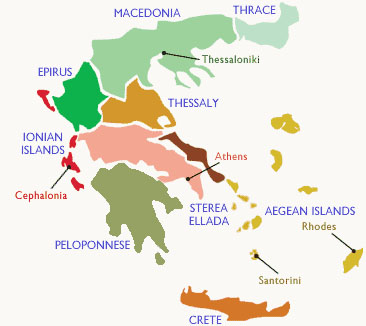
Greece has 19 major wine regions.  On the mainland Macedonia, Epirus, Peloponnese, Thessalia, Thrase and Sterea Ellada are the major communities.  The Islands also produce many wines.  The Aegean and Ionian Islands are the major classifications there.  

Perhaps the most exciting wine region in Greece is Macedonia.  Macedonia has 4 PDOs Naoussa and Amynteo (PDOs) produce transcendent dry reds from a grape called Xinomavro (Acid Black).  This is a firmly tannin heavy structured red that shares a lot of black fruit and spice, and the one we had in class was very Syrah like with a meatiness that tasted a bit like bacon.  Amynteo is Greeces coolest region and the only one that allows rose wines.  These range from still to sparkling, dry to sweet.

Slopes of Meliton (Plagies Melitona) is a single appellation PDO and it produces wines from  Cab, Cab Franc, and Limnio, Assyrtiko, Athiri and Rhoditis.

Thessalia is just south of Macedonia.  Rapsani PDO includes four villages on the lower slopes of mount olympus.  This is the furthest south you will see the Xinomavro grape and the heat of the region softens the tannins and acid.  Messenikola PDO produces reds and whites, whereas Anchialos PDO only produces white wines blended from Rodits and Savvatiano grapes that are grown in high altitude vineyards.Epirus is on the ionian coast to the west of Thessalia and contains but one PDO called Zitsa.  They produce dry, semisweet and sparkling wines from the Debina grape.

Sterea Ellada is where Retsina is still made.  Roditis is also planted there which is a quaffable pink wine that is not going to offend or excite anyone.  There are no PDOs designated here.

Peloponnese peninsula is directly south of central Greece.  There are 3 PDO zones here called Nemea, Mantinia and Patras.  Agiorgitiko (St. George) grapes are king here and make sweet and dry wines.  This is a soft tannic wine with intense black fruit flavors.   St, George from Koutsi is one of the better versions of the grape which can taste quite different depending on the elevation in which it is grown.

Peloponnese  also has PDO zones that produce whites only.  This includes Moschofilero (Similar to Muscat) is the primary grape in Mantinia PDO wines.  These are among Greece's best white wines.

Patras is an appellation of dry white wines produced from Roditis, but there are also dessert wine PDO zones as well.  Muscat of Patras, Muscat Rio Patras and Mavrodaphne of Patras.

The Ionian Islands have 4 wine producing islands which include Cephalonia, Kerkyra (Corfu), Lefkada and Zakynthos.  Cephalonia is the only ionian island to get a PDO for dry white wines. produced from Robola grapse.  PDOs for sweet wines are also produced on the island.Zakynthos produces and obscure sherry-like wine.

The Agean Islands have  many PDOs.  Crete has 2 red PDOs Archanes and Dafnes.  Sita and Peza allow both red and white wines.  Three new PDO zones were added in 2012.  These include Candia, Malvasia Candia and Malvasia Sitia.  White wines on Crete are made from Vidiano and Liatiko  (One of the most ancient grapes and one that produces "Orange" wine).  Red wines are made from Mandilaria blended with Kotsifali.  Many of the young winemakers are mixing Kotsifali with Syrah changing the landscape of Crete's winemaking.

The Cylades, so named because they form a circle around the island of Delos include wine making islands Santorini and Paros.  Santorini PDO is an exciting appelation producing wines from Assyrtiko grapes sometimes blended with Athiri and Aidani.  The vines are trained into bowls close to the ground both to save water, and to protect them against the high winds on the island.

The island has poor volcanic soils producing mineral wines from Assyrtico that often has a slight saltiness and fantastic clean, bright acidity.  A dry grape wine is produced called vinsanto, likely named by the Italians.  Paros produces red and white wines from Mandilaria(Red) and Monevvassia (White) grapes.

Samos makes Muscat of Samos PDO.  These can be Vin doux naturel, Vin de liquor and naturally sweet versions called Samos Nectar.

Lemnos and Rhodes have 2 PDOs each.  Lemnos wines are wite dominated by Muscat and may be dry or sweet.  Lemnio is the red grape and it is very ancient.  Rhodes produces PDO red and white from Mandilaria and Athiri.  Muscat of Rhodes are very rare.

So hopefully the wines of Greece will be less "Greek to you" in the future.